Saturday, May 11, 2024

30 Para Of The Holy Quran

30 Para Of The Holy Quran

Quran is the Holy book of Muslims. Allah Almighty divided the Holy Quran into 30 Paras. The division is made to make it easy for Muslims to read and learn Quran by heart. There are 114 Surahs in the Holy Quran. Further, the Quran is divided into Ayats and Rukus. 

The 30 Paras of the Holy Quran are discussed below:

ЁЯФ░Para 1 - Alif laam meem(╪в┘Д┘Е ) 

It is the first Para of the Holy Quran. It comprises two Surahs of the Holy Quran, Surah Al Fatiha, and Surah Al Baqarah. Surah Fatiha was revealed in Makkah while Surah Baqarah was revealed in Madina. Surah Fatiha explains the basic principles of the Quran. Surah Baqarah explains the errors of the followers of the earlier Prophets. It also explains the social and moral relations. The Surah Baqarah consists of Ayat Al Kursi that has the most powerful verses.

ЁЯФ░Para 2 - Sayaqulu (╪│َ┘Кَ┘Вُ┘И┘Дُ)

Sayaqulu is the second Para of the Holy Quran. The whole Para is comprised of one Surah that is Surah Al Baqarah. 

ЁЯФ░Para 3 - Tilka r Rusulu

It is the third Para of the Holy Quran. The third Para consists of two Surah.

(╪м╪з╪▒█М █Б█Т)

The first Surah is Surah Al Baqarah, and the second is Surah Al Imran. Surah Baqarah ends in this Para. Surah Al Imran is a Madni Surah. It explains the nature of Hazrat Isa (RA), the faith of Muslims in Allah Almighty, and the most important topic of the Surah is the battle of Uhud. It was the battle between the Quresh e Makkah and the Muslims.

ЁЯФ░Para 4 - Lan Tana Loo

It is the fourth Para of the Holy Quran. The Surah Al Imran ends in this Para. Surah An Nissa starts in this Para. It is the Madni Surah. The name indicates that the Surah is composed of women’s rights in society and wealth. The Surah addresses the race between men and women. This Surah also explains the issues of family and the role of women.

ЁЯФ░Para 5- Wal Mohsanat

It is the fifth Para of the Holy Quran. The whole Para is comprised of Surah An Nissa.

ЁЯФ░Para 6 - La Yahubbullah

It is the sixth Para of the Holy Quran. Two Surahs of the Holy Quran are present in this Para. Surah An Nissa ends in this Para. Surah Al Maidah begins in it. It is the Madni Surah. The Surah Al Maidah explains how jews and Christians bring changes in the original text of the Holy book Injeel.  

ЁЯФ░Para 7 - Wa Iza Samiu

It is the 7th Para of the Holy Quran. Surah Al Maida ends in this Para. Surah Al Inaam begins in this Para. Surah Al Inaam was revealed in Makkah. This Surah explains the oneness of Allah Almighty, the nature of the Holy Prophet Muhammad (SAW), and the superstitions about the animals before Islam. 

ЁЯФ░Para 8 - Wa Lau Annana

It is the 8th Para of the Holy Quran. The Surah Al Inaam starts in the 7th Para and ends in the 8th Para. A new Surah Al Araf starts in this Para. This Surah was revealed in Makkah. It explains that why Allah Almighty sends Prophets to the nations. It also explains the punishment of the people who disagree with Allah’s message. 

ЁЯФ░Para 9 - Qalal Malao

Qalal Malao is the ninth Para of the Holy Quran. Surah Al Araf ends in this Para and Surah Al Anfal starts in it. Surah Al Anfal is the Madni Surah and explains the event of the battle of Badar. This Surah deeply explains the events of the battle and its outcomes.

ЁЯФ░Para 10 - Wa A’lamu

It is the 10th Para of the Holy Quran. Surah Al Anfal ends in this Para and Surah Tauba starts in it. Surah Tauba is the first Surah of the Holy Quran that does not start with the Bismillah. The main theme of the Surah is the war. It also discusses the issues of those people who can not stick to faith.

ЁЯФ░Para 11 - Yatazeroon

It is the 11th Para of the Holy book. It consists of three Surahs. The Surah Tauba ends in this Para. Surah Younis and Surah Hud are part of this Para. Both the Surahs were revealed in Makkah. Surah Yunus explains the fundamentals of Islam. It also explains the teachings of early Prophets. Surah Hud also has similar topics. Surah Hud explains the stories of early Prophets and how Allah implements His will through the Holy Prophets.

ЁЯФ░Para 12 - Wa Mamin Da’abat

It is the 12th Para of the Quran. Surah Hud ends in this Para, and Surah Yusaf begins. This Surah was revealed in Makkah. It explains the story of the Prophet Yousaf (AS).

ЁЯФ░Para 13 - Wa Ma Ubiroo

The 13th Para of the Quran consists of three Surahs. The Surah Yusaf ends in this Para. Surah Raad and Surah Ibrahim are part of this Para. Surah Raad was revealed in Madina, while Surah Ibrahim was revealed in Makkah. 

ЁЯФ░Para 14 - Rubama

Rubama is the 14th Para of the Quran. This Para comprised of two Surahs, Surah Hijar and Surah Nahl. Both the Surahs were revealed in Makkah. 

ЁЯФ░Para 15 - Subhanallahzi

It is the 15th Para of the Quran. It comprises of two Surahs. Surah Al Isra and Surah Al Kahf are the Surahs of the Para. Both the Surahs were revealed in Makkah. Surah Kahf has great importance as it reveals the incident of Ashab e Kahf. 

ЁЯФ░Para 16 - Qal Alam

Qal Alam is the 16th Para of the Quran with three Surahs. Surah Kahf, Surah Maryam, and Surah Taha are the parts of this Para. Surah Kahf ends in this Surah. Surah Maryam and Surah Taha were revealed in Makkah.

ЁЯФ░Para 17 - Aqtarabo

It is the 17th Para with the two Surahs of the Quran, Surah Al Anbiya and Surah Al Hajj. Surah Al Anbiya was revealed in Makkah while Surah Al Hajj is Madni Surah.

ЁЯФ░Para 18 - Qadd Aflaha

It is the 18th Para with three Surahs. Surah Al Muminoon, Surah Al Furqan, and Surah Al Noor. Surah Al Noor is the Madni Surah while Surah Al Mominoon and Surah Al Furqan were revealed in Makkah. 

ЁЯФ░Para 19 - Wa Qalallazina

Wa Qalallazina is the 19th Para with three Surahs of the Quran. Surah Al Furqan, Surah Al Shu’ara, and Surah Al Namal are the parts of the 19th Para. Surah Al Furqan ends in this Para. Surah Al Shu’ara is Makki Surah while Surah Al Namal is the Madni Surah.

ЁЯФ░Para 20 - A’man Khalaq

The 20th Para of the Quran consists of three Surahs, Surah Al Namal, Al Qasas, and Surah Al Ankaboot. Surah Namal ends in this Para. Surah Al Qasas and Surah Al Ankaboot are the makki Surahs. 

ЁЯФ░Para 21 - Utlu Ma Oohi

It is the 21st Para of the Quran with the given four Surahs.

Surah Ar Room
Surah Luqmaan
Surah As Sajda
Surah Al Ahzaab

ЁЯФ░Para 22 - Wa Manyaqnut

The 22nd Para of the Holy Quran consists of the following four Surahs.

Surah Al Ahzaab
Surah Saba
Surah Faatir
Surah Yaseen

ЁЯФ░Para 23 - Wa Mali

The 23rd Para of the Holy Quran consists of the following four Surahs.

Surah Yaseen
Surah As Saaffaat
Surah Saad
Surah Az Zumar

ЁЯФ░Para 24 - Faman Azlam

The 24th Para of the Holy Quran consists of the following three Surahs.

Surah Az Zumar
Surah Ghafir
Surah fussilat

ЁЯФ░Para 25 - Elahe Yuruddo

Elahe Yuruddo is the 25th Para of the Holy Quran. The Para is comprised of the following five Surahs. 

Surah Fussilat
Surah Ash Shooraa
Surah Az Zukhruf
Surah Ad Dukhaan
Surah Al Jathiyaa

ЁЯФ░Para 26 - Ha’a Meem

Ha’a Meem is the 26th Para of the Holy Quran. The 26th Para has the following Surahs.

Surah Al Ahqaaf
Surah Muhammad
Surah Al Fath
Surah Al Hujuraat
Surah Qaaf

ЁЯФ░Para 27 - Qala Fama Khatbukum

Qala Fama Khatbukum is the 27th Para of the Holy Quran. It consists of 7 Surahs.

Surah Adh Dhaariyaat
Surah At Toor
Surah Al Najm
Surah Al Qamar
Surah Ar Rehman
Surah Al Waqia
Surah Al Hadeed

ЁЯФ░Para 28 - Qadd Sami Allah

It is the 28th Para of the Holy Quran. It is comprised of nine Surahs. 

Surah Al Mujadila
Surah Al Hashr
Surah Al Mumtahanah
Surah As Saff
Surah Al Jumu’ah
Surah Al Munafiqoon
Surah At Taghabun
Surah At Talaq
Surah At Tehreem

ЁЯФ░Para 29 - Tabarakallazi

The 29 Para has the following 11 Surahs.

Surah Al mulk
Surah Al Qalam
Surah Al Haaqqa
Surah Al Ma’aarij
Surah Nooh
Surah Al Jinn
Surah Al Muzzammil
Surah Al Muddaththir
Surah Al Qiyamah
Surah Al Insaan
Surah Al Musalaat

ЁЯФ░Para 30 - Amma Yatasa’aloon

The 30th Para of the Holy Quran consists of the following 37 Surahs.

Surah An Naba
Surah An Naazi’aat
Surah Abasa
Surah At Takweer
Surah Al Infitar
Surah Al Mutaffiffen
Surah Al Inshiqaaq
Surah Al Burooj
Surah At Tariq
Surah A’laa
Surah Al Ghaashiyah
Surah Al Fajr
Surah Al Balad
Surah Ash Shams
Surah Al Layl
Surah Ad duha
Surah Ash Sharh
Surah At Teen
Surah Al Alaq
Surah Al Qadr
Surah Al Bayyinahh
Surah Az Zalzalah
Surah Al Aadiyaat
Surah Al Qaariah
Surah At Takathur
Surah Al Asr
Surah Al Humaza
Surah Al Feel
Surah Quraysh
Surah Al Maa’oon
Surah Al Kawthar
Surah Al Kaafiroon
Surah An Nasr
Surah Al Masad
Surah Al Ikhlaas
Surah Al Falaq
Surah Al Naas

By: Zarah Begum

Friday, April 19, 2024

THOSE ACTIONS WHICH ARE EQUIVALENT IN REWARD TO PERFORMING HAJJ AND UMRAH‌ родрооிро┤ிро▓்

THOSE ACTIONS WHICH ARE EQUIVALENT IN REWARD TO PERFORMING HAJJ AND UMRAH

CONTENTS:

▪️Performing Salatul Ishraq
▪️Going to the Masjid For The Congregational Prayer
▪️Performing Salah In Masjid al-Qubah
▪️Teaching In The Masjid, Learning In A Gathering Of Knowledge In The Masjid Or Giving Jum’ah Khutbah
▪️Reciting The Adhkar After The Salah
▪️Performing Umrah In The Month Of Ramadhan
▪️Sincere and true intention
▪️A Child performing Hajj on behalf of his Parents
▪️Behaving in a good manner with your Parents
▪️Preparing the Requisites of a person traveling for Hajj
▪️Inauthentic Ahadeeth

There are numerous slaves of Allah who have the blessed opportunity to visit the House of Allah. On the other hand, there are some people who, wish day and night to visit the Haramain but due to a being financially unable, unwell or other reasons, they do not have the privilege to visit the House of Allah or Masjid e-Nabawi. These people should not become disappointed of Allah’s mercy. According to the sayings of the Prophet Muhammad Sallallahu Alaihi Wasallam, we can see that there are certain actions by which if one was to perform them, one can receive the reward of Hajj and Umrah. These have been mentioned in the below actions.

¹PERFORMING SALATUL ISHRAQ IS EQUIVALENT TO GAINING THE REWARD OF PERFORMING HAJJ AND UMRAH

Anas Ibn Malik RA narrated that the Prophet Muhammad Sallallahu Alaihi Wasallam said,

“Whoever prays Fajr in congregation, then sits remembering Allah until the sun has risen, then he prays two Rak’ah, then for him is the reward like that of a complete (and accepted) Hajj and Umrah, then for him is the reward like that of a complete (and accepted) Hajj and Umrah, then for him is the reward like that of a complete (and accepted) Hajj and Umrah. (The Prophet Muhammad Sallallahu Alaihi Wasallam repeated it 3 times for emphasis).”

[Sahih] Sunan at-Tirmidhi, hadith no.586, The Book on Traveling, Chapter: What Has Been Mentioned About What Is Recommended When Sitting After The Fajr Prayer Until The Sun Has Risen, and Albani authenticated it in Silsilah as-Sahihah, hadith no.3403.

²GOING TO THE MASJID FOR THE CONGREGATIONAL PRAYER IS EQUIVALENT TO THE REWARD OF PERFORMING UMRAH

Abu Umamah RA narrated that the Prophet Muhammad Sallallahu Alaihi Wasallam said,

“Whosoever goes out from his house for performing the prescribed prayer then, his reward will be like that of one who goes for Hajj (and it is accepted). And whosoever goes out to perform the optional prayers, will take the reward like that of a person who performs a complete Umrah (and it is accepted).”

[Sahih] Tabarani, hadith no.1528, Musnad Ahmad, hadith no.21716, Sunan Abi Dawud, hadith no.558, Sahih al-Jami’ of Albani, hadith no.6556.

³PERFORMING SALAH IN MASJID AL-QUBAH IS EQUIVALENT TO THE REWARD OF PERFORMING UMRAH

The Prophet Muhammad Sallallahu Alaihi Wasallam said,

“Whoever purifies himself (by performing the appropriate and necessary purification i.e. Ghusl, Wudhu etc.) in his house, then comes to the Quba’ Masjid and prays therein, will have a reward like that for Umrah.”

[Sahih] Sunan Ibn Majah, hadith no.1412, and Albani authenticated it in Sahih al Jami, hadith no.6154.

рооро╕்роЬிродுро▓் роХுрокாро╡ிро▓் родொро┤ுроХை роЪெроп்ро╡родு роЙроо்ро░ா роЪெроп்родродро▒்роХாрой ро╡ெроХுроородிроХ்роХு роЪроороо்


роирокி ро╕ро▓்ро▓ро▓்ро▓ாро╣ு роЕро▓ைро╣ி ро╡ро╕ро▓்ро▓роо் роЕро╡ро░்роХро│் роХூро▒ிройாро░்роХро│்.


роОро╡ро░் родройродு ро╡ீроЯ்роЯிро▓் (родроХுрои்род рооро▒்ро▒ுроо் родேро╡ைропாрой роЪுрод்родிроХро░ிрок்рокு роЕродாро╡родு роХுро╕்ро▓், роТро▓ு рокோрой்ро▒ро╡ро▒்ро▒ைроЪ் роЪெроп்родு) родрой்ройைрод் родூроп்рооைрок்рокроЯுрод்родிроХ் роХொрог்роЯு, рокிрой்ройро░் роХுрокா рооро╕்роЬிродுроХ்роХு ро╡рои்родு родொро┤ுродாро▓் роЙроо்ро░ாро╡ிро▒்роХு роЕродு рокோрой்ро▒ ро╡ெроХுроородி роХிроЯைроХ்роХுроо்.


[ро╕ро╣ீро╣்] роЪுройрой் роЗрок்ройு рооாроЬா, ро╣родீро╕் роОрог்.1412, рооро▒்ро▒ுроо் роЕро▓்рокாройி роЪாро╣ி роЕро▓் роЬாрооி, ро╣родீро╕் роОрог்.6154 роЗро▓் роЗродை роЕроЩ்роХீроХро░ிрод்родுро│்ро│ройро░்.

⁴TEACHING IN THE MASJID, LEARNING IN A GATHERING OF KNOWLEDGE IN THE MASJID OR GIVING JUM’AH KHUTBAH IS EQUIVALENT TO THE REWARD OF PERFORMING HAJJ

The Messenger of Allah SAW said,

“Whoever goes to the Masjid with the intention of learning knowledge or teaching it, then he will receive the reward of a completed and accepted Hajj.”

[Sahih] al-Mu’jam al-Kabir, The book of as-Sad, those names that are as-Sa’b, hadith no.7346, it’s chain is Sahih with Albani’s authentication in Sahih at-Targhib wa at Tarhib, hadith no.86.

рооро╕்роЬிродுро▓் роХுрокாро╡ிро▓் родொро┤ுроХை роЪெроп்ро╡родு роЙроо்ро░ா роЪெроп்родродро▒்роХாрой ро╡ெроХுроородிроХ்роХு роЪроороо்


роирокி ро╕ро▓்ро▓ро▓்ро▓ாро╣ு роЕро▓ைро╣ி ро╡ро╕ро▓்ро▓роо் роЕро╡ро░்роХро│் роХூро▒ிройாро░்роХро│்.


роОро╡ро░் родройродு ро╡ீроЯ்роЯிро▓் (родроХுрои்род рооро▒்ро▒ுроо் родேро╡ைропாрой роЪுрод்родிроХро░ிрок்рокு роЕродாро╡родு роХுро╕்ро▓், роТро▓ு рокோрой்ро▒ро╡ро▒்ро▒ைроЪ் роЪெроп்родு) родрой்ройைрод் родூроп்рооைрок்рокроЯுрод்родிроХ் роХொрог்роЯு, рокிрой்ройро░் роХுрокா рооро╕்роЬிродுроХ்роХு ро╡рои்родு родொро┤ுродாро▓் роЙроо்ро░ாро╡ிро▒்роХு роЕродு рокோрой்ро▒ ро╡ெроХுроородி роХிроЯைроХ்роХுроо்.


[ро╕ро╣ீро╣்] роЪுройрой் роЗрок்ройு рооாроЬா, ро╣родீро╕் роОрог்.1412, рооро▒்ро▒ுроо் роЕро▓்рокாройி роЪாро╣ி роЕро▓் роЬாрооி, ро╣родீро╕் роОрог்.6154 роЗро▓் роЗродை роЕроЩ்роХீроХро░ிрод்родுро│்ро│ройро░்.

⁵RECITING THE ADHKAR AFTER THE SALAH IS EQUIVALENT TO THE REWARD OF PERFORMING HAJJ AND UMRAH, AND (STRIVE/STRUGGLE) AND SADAQAH

Abu Hurairah RA narrated that,

“Some poor people came to the Prophet Muhammad Sallallahu Alaihi Wasallam and said, “The wealthy people will get higher grades and will have permanent enjoyment in Jannah and they pray like us and fast as we do. They have more money by which they perform the Hajj, and Umrah; fight and struggle in Allah’s Cause and give in charity. The Prophet Muhammad Sallallahu Alaihi Wasallam said, Shall I not tell you a thing upon which if you acted you would catch up with those who have surpassed you? Nobody would overtake you and you would be better than the people amongst whom you live except those who would do the same. Say “Subhan Allah”, “Alhamdulillah” and “Allahu Akbar” 33 times each after every (compulsory) prayer.””

Sahih Bukhari, hadith no.807. The book of Adhan, Chapter: The Dhikr (remembering Allah by Glorifying, Praising and Magnifying Him) after As-Salat (the prayer).

рооро╕்роЬிродுро▓் роХுрокாро╡ிро▓் родொро┤ுроХை роЪெроп்ро╡родு роЙроо்ро░ா роЪெроп்родродро▒்роХாрой ро╡ெроХுроородிроХ்роХு роЪроороо்


роирокி ро╕ро▓்ро▓ро▓்ро▓ாро╣ு роЕро▓ைро╣ி ро╡ро╕ро▓்ро▓роо் роЕро╡ро░்роХро│் роХூро▒ிройாро░்роХро│்.


роОро╡ро░் родройродு ро╡ீроЯ்роЯிро▓் (родроХுрои்род рооро▒்ро▒ுроо் родேро╡ைропாрой роЪுрод்родிроХро░ிрок்рокு роЕродாро╡родு роХுро╕்ро▓், роТро▓ு рокோрой்ро▒ро╡ро▒்ро▒ைроЪ் роЪெроп்родு) родрой்ройைрод் родூроп்рооைрок்рокроЯுрод்родிроХ் роХொрог்роЯு, рокிрой்ройро░் роХுрокா рооро╕்роЬிродுроХ்роХு ро╡рои்родு родொро┤ுродாро▓் роЙроо்ро░ாро╡ிро▒்роХு роЕродு рокோрой்ро▒ ро╡ெроХுроородி роХிроЯைроХ்роХுроо்.


[ро╕ро╣ீро╣்] роЪுройрой் роЗрок்ройு рооாроЬா, ро╣родீро╕் роОрог்.1412, рооро▒்ро▒ுроо் роЕро▓்рокாройி роЪாро╣ி роЕро▓் роЬாрооி, ро╣родீро╕் роОрог்.6154 роЗро▓் роЗродை роЕроЩ்роХீроХро░ிрод்родுро│்ро│ройро░்.

⁶PERFORMING UMRAH IN THE MONTH OF RAMADAN IS EQUIVALENT TO THE REWARD OF PERFORMING HAJJ

Ibn Abbas RA said,

“When the Prophet Muhammad Sallallahu Alaihi Wasallam returned after performing his Hajj, he asked Umm Sinan Al-Ansari, ‘What forbade you to perform Hajj?’ She replied, ‘My husband had two camels and he performed Hajj on one of them, and the second is used for the irrigation of our land.’ The Prophet Muhammad Sallallahu Alaihi Wasallam said (to her), ‘Performing Umrah in the month of Ramadhan, is equivalent to performing Hajj.”

And in another narration, “It is like performing Hajj with me (in reward).”

Sahih Bukhari, hadith no.1764, The Book of Penalty of Hunting while on Pilgrimage, Chapter Hajj of women, and hadith no.1690 in the Chapter of Umrah in (the month of) Ramadan.

рооро╕்роЬிродுро▓் роХுрокாро╡ிро▓் родொро┤ுроХை роЪெроп்ро╡родு роЙроо்ро░ா роЪெроп்родродро▒்роХாрой ро╡ெроХுроородிроХ்роХு роЪроороо்


роирокி ро╕ро▓்ро▓ро▓்ро▓ாро╣ு роЕро▓ைро╣ி ро╡ро╕ро▓்ро▓роо் роЕро╡ро░்роХро│் роХூро▒ிройாро░்роХро│்.


роОро╡ро░் родройродு ро╡ீроЯ்роЯிро▓் (родроХுрои்род рооро▒்ро▒ுроо் родேро╡ைропாрой роЪுрод்родிроХро░ிрок்рокு роЕродாро╡родு роХுро╕்ро▓், роТро▓ு рокோрой்ро▒ро╡ро▒்ро▒ைроЪ் роЪெроп்родு) родрой்ройைрод் родூроп்рооைрок்рокроЯுрод்родிроХ் роХொрог்роЯு, рокிрой்ройро░் роХுрокா рооро╕்роЬிродுроХ்роХு ро╡рои்родு родொро┤ுродாро▓் роЙроо்ро░ாро╡ிро▒்роХு роЕродு рокோрой்ро▒ ро╡ெроХுроородி роХிроЯைроХ்роХுроо்.


[ро╕ро╣ீро╣்] роЪுройрой் роЗрок்ройு рооாроЬா, ро╣родீро╕் роОрог்.1412, рооро▒்ро▒ுроо் роЕро▓்рокாройி роЪாро╣ி роЕро▓் роЬாрооி, ро╣родீро╕் роОрог்.6154 роЗро▓் роЗродை роЕроЩ்роХீроХро░ிрод்родுро│்ро│ройро░்.

⁷SINCERE AND TRUE INTENTION TO PERFORM HAJJ AND UMRAH FOR THE SAKE OF ALLAH.

When a Muslim sincerely intends to perform Hajj and is unable to go for some reason, or doesn’t have the means to go, Allah (Ta’ala) will write the reward of a complete Hajj for him.

It has been narrated on the authority of Jabir RA, who said: “We were with the Prophet Muhammad Sallallahu Alaihi Wasallam on an expedition. He Muhammad Sallallahu Alaihi Wasallam said: ‘There are some people in Madinah. They are with you whenever you cover a distance or cross a valley. They have been detained by illness.’” [Muslim no. 1911a]

In a version of the tradition narrated on the authority of A’mash (Rahimahullaah), we have the words: “They will share with you the reward (for Struggle).” [Muslim no. 1911b]

The Messenger of Allah SAW said:

“The world is only for four persons: A servant whom Allah provides with wealth and knowledge, so he has Taqwa of his Rabb with it, nurtures the ties of kinship with it, and he knows that Allah has a right in it. So this is the most virtuous rank. And a servant whom Allah provides with knowledge, but He does not provide with wealth. So he has a truthful intent, saying: “If I had wealth, then I would do the deeds of so-and-so with it.” He has his intention, so their rewards are the same. And a servant whom Allah provides with wealth, but He does not provide him with knowledge. [So he spends his wealth rashly without knowledge, nor having Taqwa of his Rabb, nor nurturing the ties of kinship. and he does not know that Allah has a right in it. So this is the most despicable rank. And a servant whom Allah does not provide with wealth nor knowledge, so he says: “If I had wealth, then I would do the deeds of so-and-so with it.” He has his intention, so their sin is the same.” [Sunan Al-Tirmidhi 2325; Sahih]

If you are truthful, and Allah (Ta’ala) knows if you are truthful in your request, then you will be given the full reward for the good deed.

рооро╕்роЬிродுро▓் роХுрокாро╡ிро▓் родொро┤ுроХை роЪெроп்ро╡родு роЙроо்ро░ா роЪெроп்родродро▒்роХாрой ро╡ெроХுроородிроХ்роХு роЪроороо்


роирокி ро╕ро▓்ро▓ро▓்ро▓ாро╣ு роЕро▓ைро╣ி ро╡ро╕ро▓்ро▓роо் роЕро╡ро░்роХро│் роХூро▒ிройாро░்роХро│்.


роОро╡ро░் родройродு ро╡ீроЯ்роЯிро▓் (родроХுрои்род рооро▒்ро▒ுроо் родேро╡ைропாрой роЪுрод்родிроХро░ிрок்рокு роЕродாро╡родு роХுро╕்ро▓், роТро▓ு рокோрой்ро▒ро╡ро▒்ро▒ைроЪ் роЪெроп்родு) родрой்ройைрод் родூроп்рооைрок்рокроЯுрод்родிроХ் роХொрог்роЯு, рокிрой்ройро░் роХுрокா рооро╕்роЬிродுроХ்роХு ро╡рои்родு родொро┤ுродாро▓் роЙроо்ро░ாро╡ிро▒்роХு роЕродு рокோрой்ро▒ ро╡ெроХுроородி роХிроЯைроХ்роХுроо்.


[ро╕ро╣ீро╣்] роЪுройрой் роЗрок்ройு рооாроЬா, ро╣родீро╕் роОрог்.1412, рооро▒்ро▒ுроо் роЕро▓்рокாройி роЪாро╣ி роЕро▓் роЬாрооி, ро╣родீро╕் роОрог்.6154 роЗро▓் роЗродை роЕроЩ்роХீроХро░ிрод்родுро│்ро│ройро░்.

⁸A Child Performing Hajj On Behalf Of His PARENTS

Abdullah bin Amr bin Al-Aas RA said:

“Al-Aas ibn Wa’il left his will that a hundred slaves should be emancipated on his behalf. His son Hisham emancipated fifty slaves and his son Amr intended to emancipate the remaining fifty on his behalf, but he said: “I should ask first the Messenger of Allah SAW”. He, therefore, came to the Prophet and said: “O Messenger of Allah, my father left in his will that a hundred slaves should be emancipated on his behalf and Hisham has emancipated fifty on his behalf and fifty remain.” Shall I emancipate them on his behalf? The Messenger of Allah SAW said: “Had he been a Muslim and you had emancipated slaves on his behalf, or given charity on his behalf, or performed Hajj on his behalf, it would have reached him.”

[Sunan Abu Dawud 2883; Sahih]

роТро░ு роХுро┤рои்родை родройродு рокெро▒்ро▒ோро░ிрой் роЪாро░்рокாроХ ро╣роЬ் роЪெроп்роХிро▒ாро░்


роЕрок்родுро▓்ро▓ாро╣் рокிрой் роЕроо்ро░் рокிрой் роЕро▓்-роЖро╕் RA роХூро▒ிройாро░்роХро│்:


“роЕро▓்-роЖро╕் роЗрок்ройு ро╡ாропிро▓் родройродு роЪாро░்рокாроХ роиூро▒ு роЕроЯிрооைроХро│ை ро╡ிроЯுро╡ிроХ்роХ ро╡ேрог்роЯுроо் роОрой்ро▒ு родройродு ро╡ிро░ுрок்рокрод்родை ро╡ிроЯ்роЯுро╡ிроЯ்роЯாро░்роХро│்.  роЕро╡ро░родு роороХрой் ро╣ிро╖ாроо் роРроо்рокродு роЕроЯிрооைроХро│ை ро╡ிроЯுро╡ிрод்родாро░்роХро│் рооро▒்ро▒ுроо் роЕро╡ро░родு роороХрой் роЕроо்ро░் родройродு роЪாро░்рокாроХ рооீродрооுро│்ро│ роРроо்рокродு рокேро░ை ро╡ிроЯுро╡ிроХ்роХ роОрог்рогிройாро░்роХро│், роЖройாро▓் роЕро╡ро░்роХро│் роХூро▒ிройாро░்роХро│்: "роиாрой் рооுродро▓ிро▓் роЕро▓்ро▓ாро╣்ро╡ிрой் родூродро░ிроЯроо் роХேроЯ்роХ ро╡ேрог்роЯுроо்".


роОройро╡ே, роЕро╡ро░் роирокிропро╡ро░்роХро│ிроЯроо் ро╡рои்родு роХூро▒ிройாро░்роХро│்: “роЕро▓்ро▓ாро╣்ро╡ிрой் родூродро░ே, роОрой் родрои்родை родройродு роЪாро░்рокாроХ роиூро▒ு роЕроЯிрооைроХро│ை ро╡ிроЯுро╡ிроХ்роХ ро╡ேрог்роЯுроо் роОрой்ро▒ு родройродு ро╡ிро░ுрок்рокрод்родிро▓் ро╡ிроЯ்роЯுро╡ிроЯ்роЯாро░்роХро│், рооேро▓ுроо் ро╣ிро╖ாроо் роЕро╡ро░் роЪாро░்рокாроХ роРроо்рокродு роЕроЯிрооைроХро│ை ро╡ிроЯுро╡ிроХ்роХிро▒ாро░் роХро│், рооேро▓ுроо் роРроо்рокродு рокேро░் роОроЮ்роЪிропிро░ுроХ்роХிро▒ாро░்роХро│்.  роЕро╡ро░்роХро│் роЪாро░்рокாроХ роиாрой் роЕро╡ро░்роХро│ை ро╡ிроЯுро╡ிроХ்роХро╡ா?  роЕро▓்ро▓ாро╣்ро╡ிрой் родூродро░் (ро╕ро▓்) роЕро╡ро░்роХро│் роХூро▒ிройாро░்роХро│்: "роЕро╡ро░்роХро│் роТро░ு рооுро╕்ро▓ிрооாроХ роЗро░ுрои்родு, роиீроЩ்роХро│் роЕро╡ро░்роХро│் роЪாро░்рокாроХ роЕроЯிрооைроХро│ை ро╡ிроЯுро╡ிрод்родிро░ுрои்родாро▓், роЕро▓்ро▓родு роЕро╡ро░் роЪாро░்рокாроХ родро░்роороо் роЪெроп்родிро░ுрои்родாро▓், роЕро▓்ро▓родு роЕро╡ро░்роХро│் роЪாро░்рокாроХ ро╣роЬ் роЪெроп்родிро░ுрои்родாро▓், роЕродு роЕро╡ро░்роХро│ை роЕроЯைрои்родிро░ுроХ்роХுроо்."


[роЪுройрой் роЕрокு родாро╡ூрод் 2883;  роЪாро╣ிро╣்]

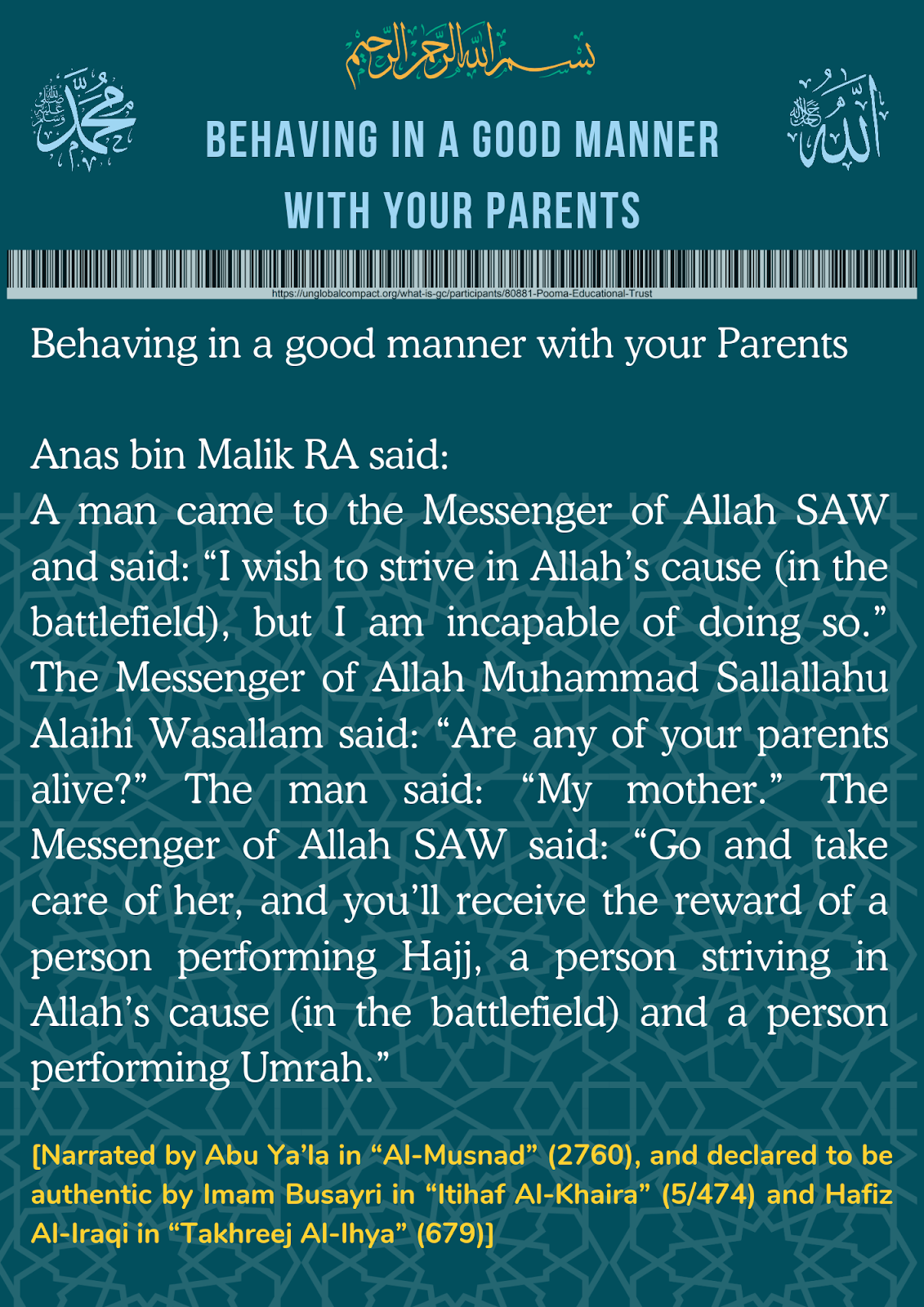
⁹BEHAVING IN A GOOD MANNER WITH YOUR PARENTS

Anas bin Malik RA said:

A man came to the Messenger of Allah (я╖║) and said: “I wish to strive in Allah’s cause (in the battlefield), but I am incapable of doing so.” The Messenger of Allah SAW said: “Are any of your parents alive?” The man said: “My mother.” The Messenger of Allah SAW said: “Go and take care of her, and you’ll receive the reward of a person performing Hajj, a person striving in Allah’s cause (in the battlefield) and a person performing Umrah.”

[Narrated by Abu Ya’la in “Al-Musnad” (2760), and declared to be authentic by Imam Busayri in “Itihaf Al-Khaira” (5/474) and Hafiz Al-Iraqi in “Takhreej Al-Ihya” (679)]

роЙроЩ்роХро│் рокெро▒்ро▒ோро░ுроЯрой் роиро▓்ро▓ рооுро▒ைропிро▓் роироЯрои்родு роХொро│்ро│ுроЩ்роХро│்


роЕройро╕் рокிрой் рооாро▓ிроХ் (ро░ро╣்) роЕро╡ро░்роХро│் роХூро▒ிройாро░்роХро│்:


роТро░ு рооройிродро░் роЕро▓்ро▓ாро╣்ро╡ிрой் родூродро░ிроЯроо் ро╡рои்родு роХூро▒ிройாро░்: "роиாрой் роЕро▓்ро▓ாро╣்ро╡ிрой் рокாродைропிро▓் (рокோро░்роХ்роХро│род்родிро▓்) рокாроЯுрокроЯ ро╡ிро░ுроо்рокுроХிро▒ேрой், роЖройாро▓் роОрой்ройாро▓் роЕро╡்ро╡ாро▒ு роЪெроп்роп роЗропро▓ாродு."  роЕро▓்ро▓ாро╣்ро╡ிрой் родூродро░் (ро╕ро▓்) роЕро╡ро░்роХро│் роХூро▒ிройாро░்роХро│்: "роЙроЩ்роХро│் рокெро▒்ро▒ோро░்роХро│ிро▓் ропாро░ாро╡родு роЙропிро░ுроЯрой் роЗро░ுроХ்роХிро▒ாро░்роХро│ா?"  роЕрои்род рооройிродро░் роХூро▒ிройாро░்: "роОрой் роЕроо்рооா."  роЕро▓்ро▓ாро╣்ро╡ிрой் родூродро░் (ро╕ро▓்) роЕро╡ро░்роХро│் роХூро▒ிройாро░்роХро│்: "роиீроЩ்роХро│் роЪெрой்ро▒ு роЕро╡ро░்роХро│ைроХ் роХро╡ройிрод்родுроХ் роХொро│்ро│ுроЩ்роХро│், роиீроЩ்роХро│் ро╣роЬ் роЪெроп்рокро╡ро░், роЕро▓்ро▓ாро╣்ро╡ிрой் рокாродைропிро▓் (рокோро░்роХ்роХро│род்родிро▓்) рокாроЯுрокроЯுрокро╡ро░் рооро▒்ро▒ுроо் роЙроо்ро░ா роЪெроп்рокро╡ро░ிрой் ро╡ெроХுроородிропைрок் рокெро▒ுро╡ீро░்роХро│்."


 [“роЕро▓்-рооுро╕்ройрод்” (2760) роЗро▓் роЕрокு ропாро▓ாро╡ாро▓் ро╡ிро╡ро░ிроХ்роХрок்рокроЯ்роЯродு, рооேро▓ுроо் “роЗродிро╣ாроГрок் роЕро▓்-роХைро░ா” (5/474) роЗро▓் роЗрооாроо் рокுро╕ைро░ி рооро▒்ро▒ுроо் “родроХ்ро░ீроЬ் роЕро▓்-роЗро╣்ропா” роЗро▓் ро╣ாроГрокிро╕் роЕро▓்-роЗро░ாроХ்роХி (2760) роЖроХிропோро░ாро▓் роЙрог்рооைропாройродு роОрой்ро▒ு роЕро▒ிро╡ிроХ்роХрок்рокроЯ்роЯродு.  679)]

¹⁰Preparing The Requisites Of A Person TRAVELING FOR HAJJ

The Prophet Muhammad Sallallahu Alaihi Wasallam said:

“Whoever prepared the necessary provisions of a person traveling for (Struggle) or Hajj, or takes care of their families (while they are away), or help a person break their fast; for them is the reward of the person fasting, doing (Struggle) or performing Hajj; and this will not decrease anything from the reward of the person fasting, doing (Struggle) or performing Hajj.”

[Sahih Ibn Khuzaimah 2064; Sahih]

ро╣роЬ்роЬுроХ்роХு рокропрогроо் роЪெроп்ропுроо் роирокро░ிрой் родேро╡ைроХро│ை родропாро░் роЪெроп்родро▓்


роирокிроХро│் роиாропроХроо் ро╕ро▓்ро▓ро▓்ро▓ாро╣ு роЕро▓ைро╣ி ро╡ро╕ро▓்ро▓роо் роЕро╡ро░்роХро│் роХூро▒ிройாро░்роХро│்:


“ро╣роЬ்роЬுроХ்роХாроХрок் рокропрогிроХ்роХுроо் роТро░ுро╡ро░ுроХ்роХுрод் родேро╡ைропாрой роПро▒்рокாроЯுроХро│ைроЪ் роЪெроп்родро╡ро░், роЕро▓்ро▓родு роЕро╡ро░்роХро│родு роХுроЯுроо்рокроЩ்роХро│ை (роЕро╡ро░்роХро│் ро╡ெро│ிропிро▓் роЗро░ுроХ்роХுроо் рокோродு) роХро╡ройிрод்родுроХ்роХொро│்роХிро▒ாро░் роЕро▓்ро▓родு роТро░ுро╡ро░ுроХ்роХு роиோрой்рокு родிро▒роХ்роХ роЙродро╡ுроХிро▒ாро░்;  роЕро╡ро░்роХро│ுроХ்роХு роиோрой்рокு роиோро▒்ро▒ு, роЕро▓்ро▓родு ро╣роЬ் роЪெроп்рокро╡ро░ிрой் ро╡ெроХுроородிропாроХுроо்;  рооேро▓ுроо் роЗродு роиோрой்рокு роиோро▒்ро▒ு, роЪெроп்рокро╡ро░ிрой் роЕро▓்ро▓родு ро╣роЬ் роЪெроп்рокро╡ро░ிрой் ро╡ெроХுроородிропிро▓ிро░ுрои்родு роОродைропுроо் роХுро▒ைроХ்роХாродு.”


[ро╕ро╣ீро╣் роЗрок்ройு роХுро╕ைрооா 2064;  роЪாро╣ிро╣்]

¹¹CLARIFYING SOME AHADEETH WHICH SAY ARE EQUIVALENT TO THE REWARD OF PERFORMING HAJJ AND UMRAH BUT ARE NOT ESTABLISHED AS BEING AUTHENTIC

Many people mention some the following phrases believing that it is a hadith: “Praying the Isha Salah in congregation will make one obtain the reward of Hajj and praying the Fajr Salah in congregation will make one obtain the reward for Umrah.”

Whilst this is not a marfu’ hadith, rather it is the saying of a tabi’i Uqbah Ibn Abdulghafar. Abu Na’im al-Isbahani mentioned this saying in Hilyatul Awliya (2/261). Therefore it is not correct to attribute this saying to the Messenger of Allah Muhammad Sallallahu Alaihi Wasallam.

Additionally, another narration is mentioned whereby if a person performs the Eid ul-Fitr, or Eid ul-Adha, or 4 rakats after the Maghrib Salah then they will obtain the reward of Hajj and Umrah. However this narration does not reach the level of being established. Another common saying which has circulated between the general people is, that if one smiles whilst looking at one’s parents then that person will receive the reward of an accepted Hajj. In this context those ahaadeeth which people present are weak. And Allah knows best. For further details please see Silsilah Ahadeeth ad-Da’ifah authored by Shaikh Albani.

May Allah bless us all with the ability to perform Hajj and Umrah or at least not let us lose out from gaining the reward of them. Aameen.

[Excerpt taken from the book ‘The Golden Actions’ by Shaykh Yahya A’rifi & Ten Deeds equivalent to the Reward of Performing Hajj and Umrah – Shaykh Zubair Marjalvi (p. 8)]

ро╣роЬ் рооро▒்ро▒ுроо் роЙроо்ро░ாро╡ை роиிро▒ைро╡ேро▒்ро▒ுро╡родро▒்роХாрой ро╡ெроХுроородிроХ்роХு роЪроорооாрой роЪிро▓ ро╣родீро╕்роХро│ை родெро│ிро╡ுрокроЯுрод்родுродро▓், роЖройாро▓் роЕро╡ை роЙрог்рооைропாройро╡ை роОрой்ро▒ு роиிро▒ுро╡рок்рокроЯро╡ிро▓்ро▓ை.


роЗродு роТро░ு ро╣родீро╕் роОрой்ро▒ு роироо்рокுроо் роЪிро▓ро░் рокிрой்ро╡ро░ுроо் роЪொро▒்ро▒ொроЯро░்роХро│ைроХ் роХுро▒ிрок்рокிроЯுроХிро▒ாро░்роХро│்: "роЗро╖ா ро╕ро▓ாро╡ை роЬрооாроЕрод்родாроХрод் родொро┤ுро╡родு ро╣роЬ்роЬுроХ்роХாрой ро╡ெроХுроородிропைрок் рокெро▒ுроХிро▒родு рооро▒்ро▒ுроо் роЬрооாроЕрод்родிро▓் роГрокроЬ்ро░் родொро┤ுроХை роТро░ுро╡ро░ை роЙроо்ро░ாро╡ுроХ்роХாрой ро╡ெроХுроородிропைрок் рокெро▒роЪ் роЪெроп்ропுроо்."


роЗродு роТро░ு рооро░்роГрокு ро╣родீро╕் роЕро▓்ро▓, рооாро▒ாроХ роЗродு роТро░ு родாрокி роЙроХ்рокா роЗрок்ройு роЕрок்родுро▓்роХроГрокாро░ிрой் роХூро▒்ро▒ு.  роЕрокு роиропீроо் роЕро▓்-роЗро╕்рокро╣ாройி ро╣ிро▓்ропродுро▓் роЕро╡்ро▓ிропாро╡ிро▓் (2/261) роЗрои்род ро╡ாро░்род்родைропைроХ் роХுро▒ிрок்рокிроЯ்роЯுро│்ро│ாро░்.  роОройро╡ே роЕро▓்ро▓ாро╣்ро╡ிрой் родூродро░் рооுро╣роо்роородு ро╕ро▓்ро▓ро▓்ро▓ாро╣ு роЕро▓ைро╣ி ро╡ро╕ро▓்ро▓роо் роЕро╡ро░்роХро│ுроХ்роХு роЗрои்род ро╡ாроЪроХроо் роХூро▒ுро╡родு роЪро░ிропро▓்ро▓.


роХூроЯுродро▓ாроХ, роТро░ு роирокро░் роИрод் роЙро▓்-рокிрод்ро░், роЕро▓்ро▓родு роИродுро▓்-роЕродா роЕро▓்ро▓родு роороХ்ро░ிрок் родொро┤ுроХைроХ்роХுрок் рокிро▒роХு 4 ро░роХ்роХாрод்роХро│ைроЪ் роЪெроп்родாро▓், роЕро╡ро░்роХро│் ро╣роЬ் рооро▒்ро▒ுроо் роЙроо்ро░ாро╡ிрой் ро╡ெроХுроородிропைрок் рокெро▒ுро╡ாро░்роХро│் роОрой்ро▒ு рооро▒்ро▒ொро░ு ро╡ிро╡ро░ிрок்рокு роХுро▒ிрок்рокிроЯрок்рокроЯ்роЯுро│்ро│родு.  роОройிройுроо் роЗрои்род ро╡ிро╡ро░ிрок்рокு роиிро▒ுро╡рок்рокроЯுроо் роиிро▓ைропை роОроЯ்роЯро╡ிро▓்ро▓ை.  рокொродு роороХ்роХро│ிроЯைропே рокுро┤роХ்роХрод்родிро▓் роЙро│்ро│ рооро▒்ро▒ொро░ு рокொродுро╡ாрой рокро┤рооொро┤ி роОрой்ройро╡ெрой்ро▒ாро▓், роТро░ுро╡ро░் родройродு рокெро▒்ро▒ோро░ைрок் рокாро░்род்родு рокுрой்ройроХைрод்родாро▓், роЕрои்род роирокро░் роПро▒்ро▒ுроХ்роХொро│்ро│рок்рокроЯ்роЯ ро╣роЬ்роЬிрой் ро╡ெроХுроородிропைрок் рокெро▒ுро╡ாро░்.  роЗрои்родроЪ் роЪூро┤ро▓ிро▓் роороХ்роХро│் рооுрой்ро╡ைроХ்роХுроо் ро╣родீро╕்роХро│் рокро▓ро╡ீройрооாройро╡ை.  рооேро▓ுроо் роЕро▓்ро▓ாро╣் роирой்роХு роЕро▒ிрои்родро╡рой்.  рооேро▓ுроо் ро╡ிро╡ро░роЩ்роХро│ுроХ்роХு ро╖ேроХ் роЕро▓்рокாройி роОро┤ுродிроп роЪிро▓்роЪிро▓ா роЕро╣родீрод் роЕрод்-родாропிроГрокாро╡ைрок் рокாро░்роХ்роХро╡ுроо்.


роЕро▓்ро▓ாро╣் роироо் роЕройைро╡ро░ுроХ்роХுроо் ро╣роЬ் рооро▒்ро▒ுроо் роЙроо்ро░ா роЪெроп்ропுроо் родிро▒ройை ро╡ро┤роЩ்роХுро╡ாройாроХ роЕро▓்ро▓родு роХுро▒ைрои்род рокроЯ்роЪроо் роЕро╡ро▒்ро▒ிрой் ро╡ெроХுроородிропைрок் рокெро▒ுро╡родிро▓் роЗро░ுрои்родு роироо்рооை роЗро┤роХ்роХாрооро▓் роЗро░ுроХ்роХроЯ்роЯுроо்.  роЖрооீрой்.


[ро╣роЬ் рооро▒்ро▒ுроо் роЙроо்ро░ா роЪெроп்родродро▒்роХாрой ро╡ெроХுроородிроХ்роХு роЪроорооாрой ро╖ேроХ் ропро╣்ропா роЕро░ிроГрокி & рокрод்родு роЪெропро▓்роХро│் роОро┤ுродிроп ‘род роХோро▓்роЯрой் роЖроХ்ро╖рой்ро╕்’ рокுрод்родроХрод்родிро▓ிро░ுрои்родு роОроЯுроХ்роХрок்рокроЯ்роЯ рокроХுродி – ро╖ேроХ் роЬுрокைро░் рооро░்роЬро▓்ро╡ி (рокроХ்роХроо் 8)]

Tuesday, March 12, 2024

TARAAWEEH AND ITS ISSUES

TARAAWEEH AND ITS ISSUES
by Asma bint Shameem

родрооிро┤ிро▓் 

1. What is Taraaweeh?   
 
Taraaweeh is the prayer that is prayed in Ramadhaan at night after praying Ishaa'. It is a confirmed Sunnah of the Prophet (Sal Allaahu Alayhi wa sallam) and a regularly established practiced of the Sahaabah. 

It is called 'Taraaweeh' because the Sahaabah used to make their prayers very long in Ramadhaan, eager to please Allaah and do their best to earn Jannah. 

And when they got tired, they would rest (istaraahu) after every two or four rak'ahs.

▪️The Prophet (Sal Allaahu Alayhi wa sallam) said: 

"Whoever prays qiyaam (Taraaweeh) in Ramadhaan out of faith and in the hope of reward, all his previous sins will be forgiven." 
(al-Bukhaari, Muslim)

▪️Al-Haafiz Ibn Rajab said:

"Note that in the month of Ramadhaan the believer engages in jihad al-nafs on two fronts: during the day by fasting and during the night by praying qiyaam. Whoever combines these two types of jihad will be given a reward without a limit."

родро░ாро╡ீро╣் роОрой்ро▒ாро▓் роОрой்рой?
 
родро░ாро╡ீро╣் роОрой்рокродு ро░рооро┤ாройிро▓் роЗро╖ாрод் родொро┤ுродுро╡ிроЯ்роЯு роЗро░ро╡ிро▓் родொро┤рок்рокроЯுроо் родொро┤ுроХைропாроХுроо்.  роЗродு роирокிроХро│் роиாропроХроо் (ро╕ро▓்) роЕро╡ро░்роХро│ிрой் роЙро▒ுродிрок்рокроЯுрод்родрок்рокроЯ்роЯ роЪுрой்ройாро╡ாроХுроо் рооро▒்ро▒ுроо் роЪро╣ாрокாроХ்роХро│ாро▓் ро╡ро┤роХ்роХрооாроХ роироЯைрооுро▒ைрок்рокроЯுрод்родрок்рокроЯ்роЯ роироЯைрооுро▒ைропாроХுроо்.

ро╕ро╣ாрокாроХ்роХро│் ро░рооро┤ாройிро▓் роЕро▓்ро▓ாро╣்ро╡ைрок் рокிро░ிропрок்рокроЯுрод்родро╡ுроо், роЬрой்ройாро╡ைрок் рокெро▒ுро╡родро▒்роХுрод் родроЩ்роХро│ாро▓் роЗропрой்ро▒родைроЪ் роЪெроп்ропро╡ுроо் роЖро╡ро▓ுроЯрой் роиீрог்роЯ роиேро░роо் родொро┤ுродродாро▓் роЗродு 'родாро░ாро╡ீро╣்' роОрой்ро▒ு роЕро┤ைроХ்роХрок்рокроЯுроХிро▒родு.

роЕро╡ро░்роХро│் роЪோро░்ро╡роЯைрои்родро╡ுроЯрой், роТро╡்ро╡ொро░ு роЗро░рог்роЯு роЕро▓்ро▓родு роиாрой்роХு ро░роХ்роЕрод்роХро│ுроХ்роХுрок் рокிро▒роХு роЕро╡ро░்роХро│் (роЗро╕்родро░ாро╣ு) роУроп்ро╡ெроЯுрок்рокாро░்роХро│்.

 ▪️роирокி (ро╕ро▓்) роЕро╡ро░்роХро│் роХூро▒ிройாро░்роХро│்:

"ропாро░் ро░рооро▓ாройிро▓் роироо்рокிроХ்роХைропுроЯройுроо், ро╡ெроХுроородிропை роОродிро░்рокாро░்род்родுроо் роХிропாроо் (родро░ாро╡ீро╣்) родொро┤ுроХிро▒ாро░ோ, роЕро╡ро░ுроЯைроп рооுрои்родைроп рокாро╡роЩ்роХро│் роЕройைрод்родுроо் роорой்ройிроХ்роХрок்рокроЯுроо்."
 (роЕро▓்-рокுроХாро░ி, рооுро╕்ро▓ிроо்)

 ▪️роЕро▓்-ро╣ாрокிро╕் роЗрок்ройு ро░роЬрок் роХூро▒ிройாро░்:

"ро░рооро┤ாрой் рооாродрод்родிро▓் роироо்рокிроХ்роХைропாро│ро░் роЬிро╣ாродுро▓்-роироГрок்ро╕ிро▓் роЗро░рог்роЯு рооுройைроХро│ிро▓் роИроЯுрокроЯுроХிро▒ாро░் роОрой்рокродை роиிройைро╡ிро▓் роХொро│்роХ: рокроХро▓ிро▓் роиோрой்рокு рооро▒்ро▒ுроо் роЗро░ро╡ிро▓் роХிропாроо் родொро┤ுроХை рооூро▓роо். роЗрои்род роЗро░рог்роЯு ро╡роХைропாрой роЬிро╣ாрод்роХро│ைропுроо் роЗрогைрод்родро╡ро░ுроХ்роХு ро╡ро░роо்рокро▒்ро▒ ро╡ெроХுроородி ро╡ро┤роЩ்роХрок்рокроЯுроо்."

 
2. Don't make it more important than Ishaa'

People are very keen to read the Taraaweeh prayer, which is very good, of course. 

That is to be highly encouraged. 

But the problem arises if we give things more importance than what Allaah places on it. 
Some people will give so much importance to Taraaweeh that they make it even more important than the Ishaa' prayer. 

They may miss Ishaa', that's acceptable to them. But they will never, ever miss Taraaweeh.  

And we all see,and know, so many people doing that. They never pray or maybe pray occasionally here and there. We never see them at the masjid, not even for Jumu'ah. And come Ramadhaan, they will come every single day to the masjid, even if they are tired, even if it is late. But they will not miss Taraaweeh.
  
Or they may even be regular in their daily prayers in Ramadhaan but after Ramadhaan is over, they stop praying altogether, although they are very, very regular and very keen to pray Taraaweeh.  

Now, please don't get me wrong. 

I'm not discouraging them from coming to Taraaweeh. At least they are making the effort, alhamdulillaah. 

It becomes an issue when Taraaweeh takes precedence and greater importance than Fardh prayers. 

Dear brothers and sisters, we have to keep our priorities straight. 

Remember that Taraaweeh prayer is MUSTAHABB, and recommended while Ishaa prayer is FARDH. 

Allaah will NOT PUNISH US if we don't pray Taraaweeh. But Allaah WILL ask us if we don't pray our FARDH prayers.  

The questioning will be about the Faraidh, the obligations, NOT the voluntary or nawaafil Ibaadaat.

роЗро╖ாро╡ை ро╡ிроЯ роЕродை рооுроХ்роХிропрооாройродாроХ роЖроХ்роХாродீро░்роХро│்

роороХ்роХро│் родро░ாро╡ீро╣் родொро┤ுроХைропை родொро┤ рооிроХро╡ுроо் роЖро░்ро╡рооாроХ роЙро│்ро│ройро░், роЗродு рооிроХро╡ுроо் роиро▓்ро▓родு.

роЗродு рооிроХро╡ுроо் роКроХ்роХுро╡ிроХ்роХрок்рокроЯ ро╡ேрог்роЯிропродு.

роЖройாро▓் роЕро▓்ро▓ாро╣் роОрои்род ро╡ிро╖ропрод்родிро▒்роХு рооுроХ்роХிропрод்родுро╡роо் роХொроЯுроХ்роХிро▒ாройோ роЕродைро╡ிроЯ роЕродிроХ рооுроХ்роХிропрод்родுро╡роо் роХொроЯுрод்родாро▓் рокிро░роЪ்роЪройை ро╡ро░ுроо்.
роЪிро▓ро░் роЗро╖ாрод் родொро┤ுроХைропை ро╡ிроЯ родро░ாро╡ீро╣்ро╡ுроХ்роХு рооுроХ்роХிропрод்родுро╡роо் роХொроЯுрок்рокாро░்роХро│்.

роЕро╡ро░்роХро│் роЗро╖ாро╡ை роЗро┤роХ்роХроХ்роХூроЯுроо், роЕродு роЕро╡ро░்роХро│ாро▓் роПро▒்ро▒ுроХ்роХொро│்ро│род்родроХ்роХродு.  роЖройாро▓் родாро░ாро╡ீропை роЕро╡ро░்роХро│் роТро░ுрокோродுроо் родро╡ро▒ро╡ிроЯ рооாроЯ்роЯாро░்роХро│்.

роиாроо் роЕройைро╡ро░ுроо் рокாро░்роХ்роХிро▒ோроо், роЕро▒ிро╡ோроо், рокро▓ро░் роЕродைроЪ் роЪெроп்роХிро▒ாро░்роХро│்.  роЕро╡ро░்роХро│் роЬெрокிроХ்роХ рооாроЯ்роЯாро░்роХро│் роЕро▓்ро▓родு роОрок்рокோродாро╡родு роЗроЩ்роХேропுроо் роЕроЩ்роХேропுроо் роЬெрокிроХ்роХ рооாроЯ்роЯாро░்роХро│்.  роЬுроо்роЖро╡ுроХ்роХுроХ் роХூроЯ роиாроо் роЕро╡ро░்роХро│ை рооро╕்роЬிродிро▓் рокாро░்рок்рокродிро▓்ро▓ை.  рооேро▓ுроо் ро░рооро┤ாрой் ро╡ாро░ுроЩ்роХро│், роЕро╡ро░்роХро│் роТро╡்ро╡ொро░ு роиாро│ுроо் рооро╕்роЬிродுроХ்роХு ро╡ро░ுро╡ாро░்роХро│், роЕро╡ро░்роХро│் роЪோро░்ро╡ாроХ роЗро░ுрои்родாро▓ுроо் роЪро░ி, родாроородрооாроХ роЗро░ுрои்родாро▓ுроо் роЪро░ி.  роЖройாро▓் родро░ாро╡ீро╣் родро╡ро▒рооாроЯ்роЯாро░்роХро│்.
  
роЕро▓்ро▓родு роЕро╡ро░்роХро│் ро░рооро▓ாройிро▓் родிройроЪро░ி родொро┤ுроХைроХро│ிро▓் роХூроЯ ро╡ро┤роХ்роХрооாроХ роЗро░ுроХ்роХро▓ாроо், роЖройாро▓் ро░рооро┤ாрой் рооுроЯிрои்род рокிро▒роХு, роЕро╡ро░்роХро│் родொро┤ுроХைропை рооுро▒்ро▒ிро▓ுрооாроХ роиிро▒ுрод்родிро╡ிроЯுро╡ாро░்роХро│், роЗро░ுрок்рокிройுроо் роЕро╡ро░்роХро│் рооிроХро╡ுроо் ро╡ро┤роХ்роХрооாройро╡ро░்роХро│ாроХро╡ுроо், родро░ாро╡ீро╣் родொро┤ுро╡родிро▓் рооிроХро╡ுроо் роЖро░்ро╡рооாроХро╡ுроо் роЙро│்ро│ройро░்.

роЗрок்рокோродு, ​​родропро╡ுроЪெроп்родு роОрой்ройை родро╡ро▒ாроХ роОрог்рогாродீро░்роХро│்.

родро░ாро╡ீро╣் ро╡ро░ுро╡родை роиாрой் роЕро╡ро░்роХро│ைрод் родроЯுроХ்роХро╡ிро▓்ро▓ை.  роХுро▒ைрои்род рокроЯ்роЪроо் роЕро╡ро░்роХро│் рооுропро▒்роЪி роЪெроп்роХிро▒ாро░்роХро│், роЕро▓்ро╣роо்родுро▓ிро▓்ро▓ாро╣்.

рокро░்ро▓ு родொро┤ுроХைропை ро╡ிроЯ родро░ாро╡ீро╣் рооுрой்ройுро░ிрооை рооро▒்ро▒ுроо் роЕродிроХ рооுроХ்роХிропрод்родுро╡роо் рокெро▒ுроо்рокோродு роЕродு роТро░ு рокிро░роЪ்роЪிройைропாроХிро▒родு.

роЕрой்рокாрой роЪроХோродро░ роЪроХோродро░ிроХро│ே, роиாроо் роироородு рооுрой்ройுро░ிрооைроХро│ை роиேро░ாроХ ро╡ைрод்родிро░ுроХ்роХ ро╡ேрог்роЯுроо்.

родро░ாро╡ீро╣் родொро┤ுроХை рооுро╕்родро╣рок் роОрой்рокродை роиிройைро╡ிро▓் роХொро│்ро│ுроЩ்роХро│், рооேро▓ுроо் роЗро╖ா родொро┤ுроХை рокро░்ро▓ு роЖроХுроо் рокோродு рокро░ிрои்родுро░ைроХ்роХрок்рокроЯுроХிро▒родு.

роиாроо் родро░ாро╡ீро╣் родொро┤ாро╡ிроЯ்роЯாро▓் роЕро▓்ро▓ாро╣் роироо்рооை родрог்роЯிроХ்роХ рооாроЯ்роЯாрой்.  роЖройாро▓் роиாроо் роироородு рокро░்ро▓ு родொро┤ுроХைропை родொро┤ро╡ிро▓்ро▓ைропா роОрой்ро▒ு роЕро▓்ро▓ாро╣் роХேроЯ்рокாрой்.

роХேро│்ро╡ிроХро│் рокро░்ро▓ு, роХроЯрооைроХро│், родрой்ройாро░்ро╡ роЕро▓்ро▓родு роирокிро▓் роЗрокாродாрод் рокро▒்ро▒ி роЕро▓்ро▓.
 
ЁЯФ╣3. Missing Taraaweeh and not praying it at all 

Indeed, Taraaweeh is one of the greatest acts of worship by means of which we can come closer to Allaah, our Lord, beg Him for forgiveness and hope for His Mercy, all the while earning immense reward from Him. 

Yet, some people don't understand the virtues of this beautiful prayer and have a very casual attitude towards it. 
They either just sit at home doing nothing, although they are awake, or they spend their time at the gym, or shopping, eating, playing, watching TV or movies, etc. and miss out on this golden chance. 

And although, *we will not be sinful* if we don't pray Taraaweeh, what a waste of abeautiful opportunity! 

Here Allaah is handing it out to us by the handfuls! 
He's showering us with blessings upon blessings...mercy upon mercy....forgiveness upon forgiveness! 
And we just sit at home and let this chance of a lifetime pass by?

What could be a greater loss than that?!! 

ЁЯФ╣4. Taraaweeh in the masjid is much better than Taraaweeh at home 
  
It is much better for the brothers to pray Taraaweeh in the masjid. 

That's because the Prophet (Sal Allaahu Alayhi wa sallam) led the people in the masjid to pray Taraaweeh for three consecutive nights, as was narrated in Saheeh Bukhaari by Aaishah Radhi Allaahu anha. 

Also that was the practice of Umar Radhi Allaahu anhu and the other Sahaabah because the Prophet (Sal Allaahu Alayhi wa sallam) said:  

"Whoever prays qiyaam with the imam until he leaves, it will be as if he spent the whole night in prayer." 
(Tirmidhi-- saheeh by al-Albaani)  
 
It was said to Ahmad ibn Hanbal: 

"Do you prefer a man to pray with the people in Ramadhaan or on his own? 

He said: 
He should pray with the people." (Tuhfat al-Ahwadhi)

ЁЯФ╣5. But Taraaweeh can also be prayed at home   

If some people cannot go to the masjid for some reason, they miss the Taraaweeh prayers all together thinking that it can only be prayed in the masjid.  

Although it is better for them to pray it in the masjid, it is also allowed to pray Taraaweeh at home. 

So don't miss out on this wonderful opportunity, thinking that you cannot pray this virtuous prayer at home. 

ЁЯФ╣6. Oh no! I missed Ishaa and they're praying Taraaweeh! 
What should I do?   

Sometimes you may get to the masjid late for whatever reason, and the Ishaa prayer has already finished. The Imaam is praying Taraaweeh, but you have not yet prayed 'Ishaa. 

So what to do? 

Don't be the like the ones who go to the back, quickly read four fast Rakaat Ishaa', separate from the rest of the congregation while they are praying Taraaweeh and then quickly join the congregation.  

That is against the etiquette of prayer, and there's no khushoo' in your fardh prayer.

Solution:

Since the Taraaweeh prayer is read ONLY after  you're done with Ishaa' so what you can do is to join the congregation and pray with them. However, you make the intention for your Ishaa prayer while they are praying with the intention of Taraaweeh.  

Then, when the Imaam finishes and says salaam after two rakaat, you don't say salaam; rather you stand up and complete the rest of your Ishaa prayer. It is perfectly OKAY for you to have a different intention and the Imaam has a different intention.

ЁЯНГ Shaikh Ibn Baaz said: 

"There is nothing wrong with his praying with them with the intention of praying 'Isha', according to the more correct of the two scholarly views. When the imam says the tasleem he should stand up and complete his prayer. It was proven in Saheeh al-Bukhaari and Muslimfrom Mu'aadh ibn Jabal that he used to pray 'Isha', then he would go back to his people and lead them in 'Isha' prayer, and the Prophet (peace and blessings of Allaah be upon him) did not denounce that. This indicates that it is permissible to offer a fard prayer behind someone who is praying a naafil prayer."
(Majmoo' Fataawa al-Shaykh Ibn Baaz) 

ЁЯФ╣7. Stay till the end 

Some people leave the congregation before the Imaam is finished because of various reasons. It could be that they want to pray more Nawaafil once they go home or they think that one shouldn't be praying more than eight rakaat (if the Imaam is reading more than that) or because they want to pray witr just before suhoor, etc. 

But in doing so, they miss out on the reward of praying the whole night. 

ЁЯНГ That's because the Prophet (Sal Allaahu Alayhi wa sallam) said: 

"Whoever prays with the imaam until he finishes, Allaah will record for him as if he spent the whole night in prayer" (al-Tirmidhi--saheeh by al-Albaani)   

So whoever finishes with the Imaam will have the reward of spending the whole night in prayer, even if you go home and sleep! Subhaan Allaah!
And whoever left early, will only get the reward of whatever he prayed.   

ЁЯНГ Someone asked Shaykh Ibn Baaz: 

If a person prays in Ramadhaan with someone who prays twenty-three rak'ahs, but he only prays eleven and does not complete the prayer with the imam, is this action of his in accordance with the Sunnah? 

He replied: "The Sunnah is to complete the prayer with the Imaam, even if he prays twenty-three rak'ahs, because the Messenger Sal Allaahu Alaiyhi wa Sallam said: 
"Whoever stands (in prayer) with the imam until he finishes, Allah will record for him (the reward of) spending a night in prayer." 

According to another report: "... The rest of that night."  

It is better for one who is praying behind an Imaam to stay with him until he finishes, whether he prays eleven rak'ahs or thirteen or twenty three or whatever. 
That is preferable, to follow the Imaam until he finishes." 
(Majmoo' Fataawa Ibn Baaz)  

ЁЯНГ And Imaam Ahmad used to pray with the Imaam and not leave until he finished, acting in accordance with the hadeeth.   

ЁЯФ╣ 8. More than one Imaam?

If there are two or more Imaams leading Taraaweeh in the masjid, then Taraaweeh prayer is the prayer of all the imaams. 
So if you want to attain the reward of spending the whole night in prayer, then do not leave until all the imaams have completed his prayer. 
 
ЁЯФ╣ 9. What if I can't stay till the end?       

Try and do your best to stay till the Imaam finishes so that you can get the reward of praying the whole night. 

However, it happens that sometimes we just have to leave even if we so desperately want to stay till the end. 
And this may be  because of very valid reasons such as work, school, kids, health reasons, etc. 

In this situation, stay as much as you can and pray whatever Allaah enables you to. 

ЁЯНГ Allaah says:

‎┘Бَ╪з╪кَّ┘Вُ┘И╪з ╪з┘Д┘Дَّ┘Зَ ┘Еَ╪з ╪з╪│ْ╪кَ╪╖َ╪╣ْ╪кُ┘Еْ  

"Therefore fear Allah as much as you are able" (Surah at-Taghaabun)

Praying even two rakaat with the Imaam is much better than not praying at all. 

And of course, Allaah is well aware of your situation and your niyyah. 

So do your best and hope in the Mercy of Allaah.

ЁЯНГ ibn al-Mubaarak said:

"Maybe a small action is made great by its intention, and maybe a great action is made small by its intention."
 
ЁЯФ╣ 10. I want to finish with the Imaam but I want to delay my Witr 
 
There are many well-known ahaadeeth which encourage us to DELAY our Witr, and to make it the LAST prayer of the night. 

That is indeed a preferred thing to do.

ЁЯНГ The Prophet (sal Allaahu Alayhi  wa sallam) said: 

"Make the last of your prayer at night Witr." (Bukhaari, Muslim)

ЁЯНГ And he (sal Allaahu Alayhi  wa sallam) said:

"Night prayers are two by two, and when you feel that dawn is approaching, pray one rak'ah." (Bukhaari, Muslim)

So you want to follow the hadeeth and make Witr your last prayer of the night but you also want to get the reward of praying the whole night when you finish with the Imaam. 

How does one do that?

When the Imaam stands up for Witr, you stand up with him and join him in the prayer. However, you make your intention to pray more rakaat for taraaweeh, although the Imaam will have the intention of praying witr. Then when the Imaam says salaam, you dont say salaam; rather you stand up and add a rakah to the Witr and make it an even number. This way you finish with the Imaam and you can then go home and pray as much Tahajjud as you want before Suhoor and then pray your witr so as to make it your last prayer of the night.  
 
ЁЯНГ Shaykh Ibn Baaz was asked: 

"When some people pray Witr with the imam and the Imaam says the salaam, they stand up and do another rak'ah so that their Witr will be at the end of the night. 
What is the ruling on doing this?  
Is it regarded as finishing the prayer with the Imaam?"  

He replied: 

"We do not know of there being anything wrong with this. 
The scholars stated that there is nothing wrong with doing that so that one will pray Witr at the end of the night. It is still true that he has stood with the imam until he finishes, because he stayed with him until the imam finished, then he prayed an extra rak'ah for a legitimate shar'i purpose, so that his Witr will be at the end of the night. 
There is nothing wrong with that, and that does not mean that he did not stay with the imam, rather he stayed with the imam until he finished, but then he did not finish with him, rather he delayed a little.” 
(Majmoo' Fataawa Ibn Baaz)   

ЁЯФ╣11. Can I pray witr twice in one night?

If you have prayed Witr with the Imaam, it is not allowed to pray Witr again at night later on.  

ЁЯНГ Shaykh Ibn Baaz was asked: 

If I have prayed Witr at the beginning of the night, then I get up to pray qiyaam at the end of the night, how should I pray? 

He replied: 

If you have prayed Witr at the beginning of the night then Allaah enables you to get up at the end of the night, then pray whatever you can two by two - without Witr, because the Prophet (sal Allaahu alaiyhi wa sallam) said: 

"There cannot be no two Witrs in one night." (al-Tirmidhi-- saheeh by al-Albaani) (Majmoo' Fataawa Ibn Baaz)   

ЁЯФ╣12. Can I pray Tahajjud/Nawaafil even after I have prayed witr? 

Indeed, the Prophet (sal Allaahu Alayhi  wa sallam) told us to make the Witr our last prayer of the night, However, this command is in the sense of it being mustahabb and preferable, not in the sense of it being obligatory and compulsory.

ЁЯНГ Proof:

When Aa'ishah Radhi Allaahu anha was asked about the Witr of the Prophet (sal Allaahu Alayhi  wa sallam) she described the way he (sal Allaahu Alayhi  wa sallam)prayed and then she said: ".... then he would pray two rak'ahs after that, whilst sitting down."
(Muslim)
 
ЁЯНГ Al-Nawawi said:  

"The correct view is that he (sal Allaahu Alayhi  wa sallam) performed these two rak'ahs after Witr sitting down, to demonstrate that it is permissible to pray after Witr, and to demonstrate that it is permissible to offer naafil prayers sitting down." 

ЁЯНГ Shaykh Ibn Baaz also said, explaining the reason why the Prophet (sal Allaahu alyahi wa sallam) prayed two rak'ahs after Witr:

"The reason for that - and Allaah knows best - is to show to the people that it is permissible to pray after Witr." (Fataawa Islamiyyah)  

ЁЯНГ Ibn Hazm said:

"Witr at the end of the night is better, but whoever prays Witr at the beginning of the night, that is fine. It is permissible to pray after Witr but one should not repeat Witr."(al-Muhalla)
   
So if you want to pray Tahajjud at night, it is permissible for you to pray Witr with the congregation, then to pray more Nawaafil after that. 

You can pray as many rak'ahs as you want two by two. 

It does not have to be only two rakaat and do not repeat Witr.  

ЁЯФ╣13. Should I pray 8 or 20?  

Some people go to extremes and fight with each other over the number of rakaat in the Taraaweeh prayer. 
They refuse to pray in the masjid that has eight rakaat or twenty rakaat and or just sit in the back if the Imaam is reading more than eight. 

Dear brothers and sisters, there's no need to fight, argue or get angry. 
It is perfectly OKAY to read EIGHT rakaat and it is ALSO OKAY to read TWENTY.
    
ЁЯНГ Proof:

A man came to the Prophet (Sal Allaahu Alayhi wa sallam) and asked: 

"How are the night prayers done? He (Sal Allaahu Alayhi wa sallam) said: 

"The night prayers are two by two, then when you fear that dawn is about to break, pray Witr with one rak'ah."
(al-Bukhaari)

Here we see that the Prophet (Sal Allaahu Alayhi wa sallam) told the man how to do the night prayer but did not specify the number of rakaat. 

Yes, the Prophet (Sal Allaahu Alayhi wa sallam) himself used to pray eight at night but when the man asked him about it, he did not tell him to pray only eight. 

Rather he left the number to him.

This shows that the matter is FLEXIBLE and broad in scope. 

A person may pray two, twenty or two hundred rakaat if he likes, and then he can pray Witr.

ЁЯНГ Imam Ahmad said:

"There is no set number of rak'ahs for qiyaam during Ramadhaan, because the Prophet (Sal Allaahu Alayhi wa sallam)  did not set a number."   

ЁЯНГ Shaykh Ibn Baaz said:    

“It is proven that 'Umar Radhi Allaahu anhu told the one whom he appointed among the Sahaabah to pray eleven rak'ahs, and it is also proven that they prayed twenty-three rak'ahs based on his command. 
This indicates that the matter is broad in scope and that the matter was flexible according to the Sahaabah. 
That is also indicated by the words of the Prophet (Sal Allaahu Alayhi wa sallam) :"The night prayers are two by two." 
(Majmoo' al-Fataawa)

ЁЯФ╣14. Can I hold the Qur'aan (Mus-haf) while praying Taraaweeh?

It is much BETTER and more preferred that one should NOT be reading from the Qur'aan while praying Taraaweeh, in order to have full concentration and better khushoo' and avoiding excessive movements.  

However, IF reading from the Qur'aan while praying Taraaweeh, gives you better understanding of what the Imaam is reading, and gives you more KHUSHOO' and concentration, then some Ulama allowed holding the Qur'aan and following the recitation of the Imaam.  And the prayer is valid. 

ЁЯНГ Someone asked Shaykh al-Albaani if it’s allowed to hold the Mus-haf and look at it while praying behind an Imaam in Taraaweeh. 

Shaikh Al-Albaani said: 

“No, no that is not from the Sunnah.”

Questioner: If he does it, is his prayer valid though?

Shaykh Al-Albaani: 
“His prayer is valid.”

Questioner: 
“But in opposition to the Sunnah?”

Shaykh Al-Albaani: “Yes”.
(Al-Hudaa wan-Noor, 679)

ЁЯФ╣15. Taraweeh is proven from the Sunnah; it is NOT a bid'ah     

The Taraaweeh prayer is a CONFIRMED SUNNAH of the Prophet (Sal Allaahu alayhi wa sallam) and the established practice of his Sahaabah. 

The Prophet (sal Allaahu alayhi wa sallam) HIMSELF prayed it and led the people as did the Sahaabah, Tabi'een and the great Ulama of the following generations, following his example. 
 
ЁЯНГ Proof:

Aa'ishah Radhi Allaahu anha said that the Messenger of Allaah (sal Allaahu alayhi wa sallam) prayed one night in the masjid, and the people followed him in prayer. Then he prayed the next night, and many people came. Then they gathered on the third or fourth night, and the Messenger of Allaah (sal Allaahu alaiyhi wa
sallam) did not come out to them. 

The next morning he (sal Allaahu alayhi wa sallam) said: "I saw what you did, and nothing kept me from coming out to you except the fact that I FEARED that it would be made OBLIGATORY for you." And that was in Ramadhaan." (al-Bukhaari and Muslim)
  
This proves that praying Taraweeh in congregation is prescribed according to the Sunnah of the Prophet (sal Allaahu alayhi wa sallam), but he (sal Allaahu alayhi wa sallam) refrained from doing it continuously because he feared that it might become fardh on me and you. 

When the Prophet (sal Allaahu alayhi wa sallam) passed away, Umar Radhi Allaahu anhu revived this Sunnah since this reservation was no longer there, because the Sharee'ah was established and complete.  
 
ЁЯНГ When Ali Radhi Allaahu anhu passed by the masaajid in which there were lamps during the month of Ramadhaan, he said:

'May Allaah illuminate Umar's grave for him as he illuminated our mosques for us." (al-Mughni).  
 
ЁЯФ╣16. Any specific duas to be read in between every two or four rakaat❓

There is a very common misconception that there are some specific duas (called 'Dua Taraaweeh') to be read in between the rakaat. 
You see people reading it and even some masaajid have overhead projectors that highlight and show these duas to the people so that they can read them.

There is NO PROOF in the Sharee'ah for that. 
    
And neither the imam nor those praying behind him should read those duas.

That's because acts of worship are 'tawqeefi' which mean that Ibaadah is governed by the principle that nothing is permitted except that which was prescribed by the Prophet sal Allaahu alayhi wa sallam.

Constantly doing a particular act of worship at a particular time without any evidence for that from the Sharee'ah comes under the heading of BID’AH or innovation. 

ЁЯНГ The Prophet (sal Allaahu alayhi wa sallam)  said: "Whoever does an action that is not part of this matter of ours (Islam) will have it rejected." 
(al-Bukhaari, Muslim)

ЁЯФ╣17. Finishing the Qur'aan in Taraaweeh early does NOT mean there's no more Taraaweeh 

Some people are under the impression that if they finish the recitation of the Qur'aan early in Ramadhaan, then there's no more Taraaweeh.  

That's absolutely NOT TRUE.  

The main goal in Ramadhaan is to stand in qiyaam at night...every single night, read a lot of Qur'aan and reflect on the ayaat....NOT to quickly finish the Qur'aan from cover to cover whether in five days or ten days or whatever and then the rest of Ramadhaan, you are 'off' from Taraaweeh! 

Reading the Qur'aan in Taraaweeh is not a 'chore' or 'burden' that you get off your head. It is to humble yourself before Allaah, get yourself away from the dunya and its glamor and bring yourself back to the reality that one day we have to face our Lord and give account of ourselves. 

It is hard to believe that there are masaajid in Pakistan that hold Taraaweeh prayers in the first ten days of Ramadhaan ONLY. 
Why? 
So that they are 'done' with Taraaweeh and they don't have to pray this beautiful prayer for the rest of the nights of Ramadhaan because they 'finished' the Qur'aan. 
Now they can do what they want; relax, shop, have fun, go to sleep... basically go back to their 'pre-Ramadhaan' state! 

May Allaah guide us all and enable us to see and realize the real purpose of fasting and qiyaam and enable us to achieve that. Ameen.
 
And Allaah knows Best.

Tuesday, February 20, 2024

Virtues of Ramadan

◽13 Virtues of Ramadan ◽What are the virtues of Ramadan?◽Ramadan is venerated in Islam and it is distinguished from the other lunar months by a number of characteristics and virtues which are explained in the detailed answer.Praise be to Allah.◽Ramadan is one of the twelve Arabic months. It is a month which is venerated in the Islamic religion, and it is distinguished from the other months by a number of characteristics and virtues, including the following: ◽1- Allah has made fasting this month the fourth pillar of Islam , as He says (interpretation of the meaning): ◽“The month of Ramadan in which was revealed the Quran, a guidance for mankind and clear proofs for the guidance and the criterion (between right and wrong). So whoever of you sights (the crescent on the first night of) the month (of Ramadan i.e. is present at his home), he must observe Sawm (fasts) that month…” [al-Baqarah 2:185]◽And it was narrated in al-Sahihayn (al-Bukhari, 8; Muslim, 16) from the hadith of Ibn ‘Umar that the Prophet (peace and blessings of Allah be upon him) said: “Islam is built on five (pillars): the testimony that there is no god except Allah and that Muhammad (peace and blessings be upon him) is the Messenger of Allah; establishing prayer; paying zakah; fasting Ramadan; and Hajj to the House (the Ka’bah).” ◽2- Allah revealed the Quran in this month, as He says in the verse quoted above (interpretation of the meaning): ◽“The month of Ramadan in which was revealed the Quran, a guidance for mankind and clear proofs for the guidance and the criterion (between right and wrong)…” [al-Baqarah 2:185]◽And Allah says (interpretation of the meaning): “Verily, We have sent it (this Quran) down in the Night of Al-Qadr (Decree).” [al-Qadr 97:1]◽3- Allah has made Laylat al-Qadr in this month, which is better than a thousand months, as Allah says (interpretation of the meaning): ◽“Verily, We have sent it (this Quran) down in the Night of Al-Qadr (Decree). And what will make you know what the Night of Al-Qadr (Decree) is? The Night of Al-Qadr (Decree) is better than a thousand months (i.e. worshipping Allah in that night is better than worshipping Him a thousand months, i.e. 83 years and 4 months). Therein descend the angels and the Ruh [Jibreel (Gabriel)] by Allah’s Permission with all Decrees, (All that night), there is peace (and goodness from Allah to His believing slaves) until the appearance of dawn.” [al-Qadar 97:1-5] ◽“We sent it (this Quran) down on a blessed night [(i.e. the Night of Al-Qadr) in the month of Ramadan — the 9th month of the Islamic calendar]. Verily, We are ever warning [mankind that Our Torment will reach those who disbelieve in Our Oneness of Lordship and in Our Oneness of worship].” [al-Dukhan 44:3]◽Allah has blessed Ramadan with Laylat al-Qadr . Explaining the great status of this blessed night, Surat al-Qadr was revealed, and there are many ahadith which also speak of that, such as the hadith of Abu Hurayrah (may Allah be pleased with him) who said: The Messenger of Allah (peace and blessings of Allah be upon him) said: “There has come to you Ramadan, a blessed month which Allah has enjoined you to fast, during which the gates of heaven are opened and the gates of Hell are closed, and the rebellious devils are chained up. In it there is a night which is better than a thousand months, and whoever is deprived of its goodness is indeed deprived.” (Narrated by al-Nasai, 2106; Ahmad, 8769, classed as sahih by al-Albani in Sahih al-Targhib, 999.)◽And Abu Hurayrah (may Allah be pleased with him) said: The Messenger of Allah (peace and blessings of Allah be upon him) said: “Whoever spends Laylat al-Qadr in prayer out of faith and in the hope of reward, will be forgiven his previous sins.” (Narrated by al-Bukhari, 1910; Muslim, 760)◽4- Allah has made fasting Ramadan and spending its nights in prayer out of faith and in the hope of reward a means of forgiveness of sins, as was proven in al-Sahihayn (al-Bukhari, 2014; Muslim, 760) from the hadith of Abu Hurayrah according to which the Prophet (peace and blessings of Allah be upon him) said: “Whoever fasts Ramadan out of faith and in the hope of reward, his previous sins will be forgiven.” ◽Al-Bukhari (2008) and Muslim (174) also narrated from Abu Hurayrah that the Prophet (peace and blessings of Allah be upon him) said: “Whoever spends the nights of Ramadan in prayer out of faith and in the hope of reward, his previous sins will be forgiven.” ◽The Muslims are unanimously agreed that it is Sunnah to pray qiyam at night in Ramadan. Al-Nawawi said that what is meant by praying qiyam in Ramadan is to pray Tarawih, i.e., one achieves what is meant by qiyam by praying Tarawih. ◽5- In this month, Allah opens the gates of Paradise and closes the gates of Hell , and chains up the devils, as is stated in al-Sahihayn (al-Bukhari, 1898; Muslim, 1079), from the hadith of Abu Hurayrah who said that the Messenger of Allah (peace and blessings of Allah be upon him) said: “When Ramadan comes, the gates of Paradise are opened and the gates of Hell are closed, and the devils are chained up.” ◽6- Every night Allah has people whom He redeems from the Fire. Imam Ahmad (5/256) narrated from the hadith of Abu Umamah that the Prophet (peace and blessings of Allah be upon him) said: “At every breaking of the fast, Allah has people whom He redeems.” Al-Mundhiri said: there is nothing wrong with its isnad; and it was classed as sahih by al-Albani in Sahih al-Targhib, 987. ◽7- Fasting Ramadan is a means of expiation for the sins committed since the previous Ramadan, so long as one avoids major sins. It was proven in Sahih Muslim (233) that the Prophet (peace and blessings of Allah be upon him) said: “The five daily prayers, from one Jumu’ah to the next and from one Ramadan to the next are expiation for (sins committed) in between, so long as you avoid major sins.” ◽8- Fasting in Ramadan is equivalent to fasting ten months, as is indicated by the hadith in Sahih Muslim (1164) narrated from Abu Ayyub al-Ansari: “Whoever fasts Ramadan then follows it with six days of Shawwal , it will be like fasting for a lifetime.”◽Ahmad (21906) narrated that the Prophet (peace and blessings of Allah be upon him) said: “Whoever fasts Ramadan, a month is like ten months, and fasting six days after al-Fitr will complete the year.” ◽9- Whoever prays qiyam in Ramadan with the imam until he finishes, it will be recorded for him that he spent the whole night in prayer, because of the report narrated by Abu Dawud (1370) and others from the hadith of Abu Dharr (may Allah be pleased with him) that the Messenger of Allah (peace and blessings of Allah be upon him) said: “Whoever prays qiyam with the imam until he finishes, it will be recorded for him that he spent the whole night in prayer.” (Classed as sahih by al-Albani in Salat al-Tarawih, p. 15)◽10- ‘Umrah in Ramadan is equivalent to Hajj . Al-Bukhari (1782) and Muslim (1256) narrated that Ibn ‘Abbas said: The Messenger of Allah (peace and blessings of Allah be upon him) said to a woman among the Ansar, “What kept you from doing Hajj with us?” She said, “We only had two camels that we used for bringing water.” So her husband and son had gone for Hajj on one camel, and he left the other for them to use for bringing water.” He said, “When Ramadan comes, go for ‘Umrah, for ‘Umrah in Ramadan is equivalent to Hajj.” According to a report narrated by Muslim, “… is equivalent to doing Hajj with me.” ◽11- It is Sunnah to observe i’tikaf (retreat for the purpose of worship) in Ramadan, because the Prophet (peace and blessings of Allah be upon him) always did that, as it was narrated in the hadith of ‘Aishah (may Allah be pleased with her) that the Prophet (peace and blessings of Allah be upon him) used to spend the last ten days of Ramadan in i'tikaf until he passed away, then his wives observed i'tikaf after him.” Narrated by al-Bukhari, 1922; Muslim, 1172. ◽12- It is mustahabb in the sense of being strongly recommended in Ramadan to study the Quran together and to read it a great deal. You may study the Quran together by reciting it to someone else and by having someone else recite it to you. The evidence that this is mustahabb is the fact that Jibril used to meet the Prophet (peace and blessings of Allah be upon him) every night in Ramadan and study the Quran with him. (Narrated by al-Bukhari, 6; Muslim, 2308)Reading Quran is mustahabb in general, but more so in Ramadan. ◽13- It is mustahabb in Ramadan to offer iftar to those who are fasting , because of the hadith of Zayd ibn Khalid al-Juhani (may Allah be pleased with him) who said: The Messenger of Allah (peace and blessings of Allah be upon him) said: “Whoever gives iftar to one who is fasting will have a reward like his, without that detracting from the fasting person’s reward in the slightest.” (Narrated by al-Tirmidhi, 807; Ibn Majah, 1746; classed as sahih by al-Albani in Sahih al-Tirmidhi, 647.)  And Allah knows best.

Monday, February 5, 2024

Shab e Miraj

Shab e Miraj
7 Feb 24, Wednesday, India 
родрооிро┤ிро▓் 

In the name of Allah, Most Gracious, Most Merciful

When is Shab e Miraj 2024?

This year, Shab e Meeraj / Isra and Meraj 2024 is expected to be on the night of Wednesday February 7th, 2024. However, the exact date is subject to the sighting of the moon of Rajab, 1445. 

What is Isra and Meraj? 

The Night Journey, also known as Shab e Miraj, Isra, and Miraj or Al Isra wal Miraj, is observed on the 27th day of the month of Rajab (7th month of Islamic Calendar). Shab e Miraj literally translates to The Night of Ascent. This event celebrates the night when the Prophet (S.A.W.) ascended to the Heavens from Masjid Al-Haram in Makkah. One of the great gifts of this night was that obligatory Prayer (Fardh Salah) was instituted on Muslims. 

Similar to other events and occasions of the blessed life of our Prophet (S.A.W.), The Night Journey is a rich source of inspiration and lessons for the entire humanity.  

Background:

Isra and Miraj took place approximately 10-12 years after Prophet (S.A.W.) received revelation from Allah. This was a time of great sorrow and grief for the Prophet (S.A.W.) because of the recent deaths of his beloved wife Khadijah (R.A.) and his uncle Abu Talib. However, in this difficult times, Prophet (S.A.W.) was honored with direct contact with Allah through this blessed journey.

Story of Shab e Miraj:

This miraculous journey of Miraj took place in two parts. First, Prophet Mohammad (S.A.W.) went from Makkah (Kaaba) to Jerusalem (Masjid Al-Aqsa) and then he (S.A.W) ascended to the heavens by the will of Allah.

The night started off with the leader of all Angels Jibrael (A.S.) appearing before the Prophet (S.A.W.). Subsequently, he took Mohammad (S.A.W.) from the Masjid Al-Haram (Kaaba) to the Masjid Al-Aqsa in Jerusalem. This part of the Prophet's (S.A.W.) journey is mentioned in Quran: 

"Exalted is He who took His Servant by night from al-Masjid al-Haram to al-Masjid al-Aqsa, whose surroundings We have blessed, to show him of Our signs. Indeed, He is the Hearing, the Seeing." (Surah Al-Isra 17:1)

The mode of transportation used for this commute in the middle of the night was an animal, similar to a horse, called Al-Burraq which was sent by Allah from Jannah (Paradise). After riding this heavenly ride, he (S.A.W.) reached Masjid Al-Aqsa from Masjid al-Haram in just a second. On reaching Masjid Al-Aqsa, Prophet Mohammad (S.A.W.) realized that all the other Prophets, who came before him, were already present there. These Prophets include Ibrahim (A.S.), Isa (A.S.), Musa (A.S.), and all other Prophets. Over here Mohammad (S.A.W.) led all of the Prophets in two Rakat prayers.

After that, two cups were brought to the Prophet (S.A.W.). One cup was filled with wine and the other with milk. He (S.A.W.) looked at them and chose the milk. Jibrael (A.S.) said to him (S.A.W.):

'Praise be to Allah Who has guided you to the Fitrah (purity and innocence). If you have chosen the wine, your Ummah would have gone astray.' (An-Nasai: 5657)

Prophet's Ascension to Heavens:

In the second part of Isra and Miraj, Jibrael (A.S.) took Prophet (S.A.W.) to the heavens. Through his ascension, Prophet Mohammad (S.A.W.) stopped by all seven layers of the heaven/sky.  

Messenger of Allah (S.A.W.) met the following great Prophets on each heaven: 

¹On first heaven, Prophet Adam (A.S.) 
²On second heaven, Prophet Isa (A.S.) and Prophet Yahya (A.S.) [Prophet Jesus and Prophet John]
³On third heaven, Prophet Yusuf (A.S.) [Prophet Joseph]
⁴On fourth heaven, Prophet Idris (A.S.) [Prophet Enoch]
⁵On fifth heaven, Prophet Haroon (A.S.) [Prophet Aaron]
⁶On sixth heaven, Prophet Musa (A.S.) [Prophet Moses]
⁷On seventh heaven, Prophet Ibrahim (A.S.) [Prophet Abraham]
(Ref: Sahih Bukhari: 3207)

Bait Al-Mamur and Sidrat Al-Muntaha:

Prophet (S.A.W.) was shown Al-Bait Al-Mamur (Allah's House on top of all heavens). Upon inquiring about this place, Jibrael (A.S) told Prophet (S.A.W.), 

'This is Al Bait- Al-Mamur where 70,000 angels perform prayers daily and who attends it never will never be able to again attend this blessing.' (Sahih Bukhari: 3207)

The Prophet (S.A.W.) was carried to Sidrat Al-Muntaha (a large Lote-Tree which marks the end of heavens). Sidrat Al-Muntaha is the boundary which no creation of Allah can pass. Jibrael (A.S.) stopped at this tree whereas Prophet Mohammad (S.A.W.) is the only being who was allowed by Allah to pass this boundary. 

Did Prophet (S.A.W.) see Allah?

After Prophet (S.A.W.) crossed Sidrat Al-Muntaha, he (S.A.W.) was then presented to the Divine Presence and got the closest possible nearness to Allah but Prophet (S.A.W.) did not see Allah with his eyes. The same is also evident from the following hadith: 

It was narrated that Aishah (R.A.) said: ?If anyone tells you that Mohammad (S.A.W.) has seen his Lord, he is a liar, for Allah says: 'No vision can grasp Him.' (Surah Al-Anaam 6:103) (Sahih Bukhari: 7380) 

Ordination of Five Daily Prayers:

During the Devine Presence of Allah, Prophet (S.A.W.) was ordained 50 daily prayers for him and his Ummah. After receiving this order from Allah, Prophet (S.A.W.) returned and was on his way back but Prophet Musa (A.S.) advised him to ask Allah to reduce the number because the Muslim Ummah would not be able to perform such a large number of prayers. Prophet (S.A.W.) went again and again to Almighty Allah till the prayers were reduced to five only but Allah Has promised his beloved Prophet (S.A.W.) that the reward from Allah of these five Prayers for His slaves will be equal to fifty prayers (SubhanAllah).  

Gifts of Isra and Miraj:

The Messenger of Allah (S.A.W.) was given three things during this blessed journey:

1. Five daily Prayers (which equal to the reward of fifty daily Prayers). (Sahih Bukhari: 7517)

2. Concluding verses of Surah Al-Baqarah (Last Two Verses.

3. Allah's Promise that the sins of the Ummah of Mohammad (S.A.W.) would be forgiven except those who died associating partners with Allah. (Sahih Muslim: 173)

Prophet (S.A.W) was shown "Jannah" and "Jahannum"

During this journey of Miraj, the Prophet (S.A.W.) was also taken to Jannah (Paradise) and Jahannum (Hell) by Angel Jibrael (A.S.). During this visit, Prophet (S.A.W.) saw the blessing which will be received by the inhabitants of paradise but also saw the tortures and torments which will be inflicted on the people who will enter hell. 

Prophet (S.A.W.) came back to Makkah:

After completing his journey, Prophet (S.A.W.) mounted Al-Buraq and returned to Makkah. The Shab e Miraj took place during one night.

The next morning, Prophet (S.A.W.) went to Masjid Al-Haram and told people about his journey. The disbelievers found this situation suitable to humiliate the believers. They knew that Prophet (S.A.W.) had never been to Masjid Al-Aqsa so they asked him about its description. Disbelievers were amazed at the Prophet's (S.A.W.) answer and exact description of the Mosque. They said to Prophet (S.A.W.): 'By God, you perfectly and correctly described it.' Nevertheless, they still did not embrace Islam and asked for more proof.

When a group of disbelievers told Abu Bakr (R.A.) about the situation, he (R.A.) said to them, If Prophet (S.A.W.) said this, then it is undoubtedly true.' This shows Abu Bakr's true beliefs and due to this incident, Abu Bakr (R.A.) was given the title of "As-Siddiq" (the Truthful)" by the Prophet (S.A.W.).

Conclusion:

Shab e Miraj holds great significance in the lives of Muslims across the globe. It is considered one of the most sacred of miracles of Allah, which He chose to bestow upon Prophet Mohammad (S.A.W.) and only him. 

Although this journey has religious significance in Islam, the Prophet Mohammad (S.A.W.) never celebrated it nor did he ever instruct his Ummah to celebrate it. However, we can commemorate this great event by asking Allah for His blessings, helping the needy and by doing good deeds which Allah and His Messenger (S.A.W.) have advised/taught us to do.

ро╖рок் роЗ рооிро░ாроЬ்
7 рокிрок்ро░ро╡ро░ி 24, рокுродрой், роЗрои்родிропா

роЕро▓்ро▓ாро╣்ро╡ிрой் рокெропро░ாро▓், рооிроХ்роХ роЕро░ுро│ாро│ро░், рооிроХ்роХ роХро░ுрогைропாро│ро░்

ро╖рок் роЗ рооிро░ாроЬ் 2024 роОрок்рокோродு?

роЗрои்род роЖрог்роЯு, ро╖рок் роЗ рооீро░ாроЬ் / роЗро╕்ро░ா рооро▒்ро▒ுроо் рооெро░ாроЬ் 2024 рокிрок்ро░ро╡ро░ி 7, 2024 рокுродрой்роХிро┤рооை роЗро░ро╡ு роЗро░ுроХ்роХுроо் роОрой்ро▒ு роОродிро░்рокாро░்роХ்роХрок்рокроЯுроХிро▒родு. роЗро░ுрок்рокிройுроо், роЪро░ிропாрой родேродி ро░роЬрок், 1445 роЗрой் рокிро▒ை рокாро░்род்родродро▒்роХு роЙроЯ்рокроЯ்роЯродு.

роЗро╕்ро░ா рооро▒்ро▒ுроо் рооெро░ாроЬ் роОрой்ро▒ாро▓் роОрой்рой?

ро╖рок் роЗ рооிро░ாроЬ், роЗро╕்ро░ா, рооро▒்ро▒ுроо் рооிро░ாроЬ் роЕро▓்ро▓родு роЕро▓் роЗро╕்ро░ா ро╡ро▓் рооிро░ாроЬ் роОрой்ро▒ுроо் роЕро┤ைроХ்роХрок்рокроЯுроо் роЗро░ро╡ுрок் рокропрогроо், ро░роЬрок் рооாродрод்родிрой் 27ро╡родு роиாро│ிро▓் (роЗро╕்ро▓ாрооிроп роиாроЯ்роХாроЯ்роЯிропிрой் 7ро╡родு рооாродроо்) роЕройுроЪро░ிроХ்роХрок்рокроЯுроХிро▒родு.  ро╖рок் роЗ рооிро░ாроЬ் роОрой்рокродு родி роиைроЯ் роЖроГрок் роЕроЪெрой்роЯ் роОрой்ро▒ு рооொро┤ிрокெропро░்роХ்роХрок்рокроЯ்роЯுро│்ро│родு.  роЗрои்род роиிроХро┤்ро╡ாройродு роирокி (ро╕ро▓்) роЕро╡ро░்роХро│் роороХ்роХாро╡ிро▓் роЙро│்ро│ рооро╕்роЬிродுро▓் ро╣ро░ாрооிро▓ிро░ுрои்родு роЪொро░்роХ்роХрод்родிро▒்роХு роПро▒ிроп роЗро░ро╡ைроХ் роХொрог்роЯாроЯுроХிро▒родு.  роЗрои்род роЗро░ро╡ிрой் рокெро░ிроп рокро░ிроЪுроХро│ிро▓் роТрой்ро▒ு, рооுро╕்ро▓ிроо்роХро│் рооீродு роХроЯрооைропாрой родொро┤ுроХை (роГрокро░்род் ро╕ро▓ாро╣்) роПро▒்рокроЯுрод்родрок்рокроЯ்роЯродு.

роироородு роирокி (S.A.W.) роЕро╡ро░்роХро│ிрой் роЖроЪீро░்ро╡родிроХ்роХрок்рокроЯ்роЯ ро╡ாро┤்роХ்роХைропிрой் рокிро▒ роиிроХро┤்ро╡ுроХро│் рооро▒்ро▒ுроо் роЪрои்родро░்рок்рокроЩ்роХро│ைрок் рокோро▓ро╡ே, роЗро░ро╡ுрок் рокропрогроо் рооுро┤ு рооройிродроХுро▓род்родிро▒்роХுроо் роЙрод்ро╡ேроХроо் рооро▒்ро▒ுроо் рокроЯிрок்рокிройைроХро│ிрой் ро╡ро│рооாрой роЖродாро░рооாроХுроо்.

рокிрой்ройрогி:

роирокி (ро╕ро▓்) роЕро╡ро░்роХро│் роЕро▓்ро▓ாро╣்ро╡ிроЯрооிро░ுрои்родு ро╡ро╣ிропைрок் рокெро▒்ро▒ு роЪுрооாро░் 10-12 роЖрог்роЯுроХро│ுроХ்роХுрок் рокிро▒роХு роЗро╕்ро░ாро╡ுроо் рооிро░ாроЬூроо் роиிроХро┤்рои்родрой.  роирокிроХро│் роиாропроХроо் (ро╕ро▓்) роЕро╡ро░்роХро│ிрой் роЕрой்рокு рооройைро╡ி роХродீроЬா (ро░ро▓ி) рооро▒்ро▒ுроо் роЕро╡ро░родு рооாрооா роЕрокுродாро▓ிрок் роЖроХிропோро░ிрой் роЪрооீрокрод்родிроп рооро░рогроо் роХாро░рогрооாроХ роЗродு рооிроХро╡ுроо் роЪோроХрооாроХро╡ுроо் родுроХ்роХрооாроХро╡ுроо் роЗро░ுрои்родродு.  роЗро░ுрок்рокிройுроо், роЗрои்род роХроЯிройрооாрой роХாро▓роЩ்роХро│ிро▓், роЗрои்род роЖроЪீро░்ро╡родிроХ்роХрок்рокроЯ்роЯ рокропрогрод்родிрой் рооூро▓роо் роирокி (ро╕ро▓்) роЕро╡ро░்роХро│் роЕро▓்ро▓ாро╣்ро╡ுроЯрой் роиேро░роЯிропாроХ родொроЯро░்рокு роХொрог்роЯு роХௌро░ро╡ிроХ்роХрок்рокроЯ்роЯройро░்.

ро╖рок் роЗ рооிро░ாроЬ் роХродை:

рооீро░ாроЬிрой் роЗрои்род роЕродிроЪроп рокропрогроо் роЗро░рог்роЯு рокроХுродிроХро│ாроХ роироЯрои்родродு.  рооுродро▓ிро▓், рооுро╣роо்роородு роирокி (ро╕ро▓்) роЕро╡ро░்роХро│் роороХ்роХாро╡ிро▓ிро░ுрои்родு (роХроЕрокா) роЬெро░ுроЪро▓ேрооுроХ்роХு (рооро╕்роЬிродுро▓் роЕроХ்ро╕ா) роЪெрой்ро▒ாро░்роХро│், рокிрой்ройро░் роЕро▓்ро▓ாро╣்ро╡ிрой் ро╡ிро░ுрок்рокрок்рокроЯி ро╡ிрог்рогுро▓роХிро▒்роХுроЪ் роЪெрой்ро▒ாро░்роХро│்.

роЕройைрод்родு рооро▓роХ்роХுрооாро░்роХро│ிрой் родро▓ைро╡ро░ாрой роЬிрок்ро░ிропро▓் (роЕро▓ை) роЕро╡ро░்роХро│் роирокி (ро╕ро▓்) роЕро╡ро░்роХро│ிрой் рооுрой் родோрой்ро▒ிропро╡ுроЯрой் роЗро░ро╡ு родொроЯроЩ்роХிропродு.  родொроЯро░்рои்родு, рооро╕்роЬிрод் роЕро▓்-ро╣ро░ாрооிро▓் (роХроЕрокா) роЗро░ுрои்родு роЬெро░ுроЪро▓ேрооிро▓் роЙро│்ро│ рооро╕்роЬிродுро▓்-роЕроХ்ро╕ாро╡ிро▒்роХு рооுроХроо்роородுро╡ை (SAW) роЕро┤ைрод்родுроЪ் роЪெрой்ро▒ாро░்роХро│்.  роирокி (ро╕ро▓்) роЕро╡ро░்роХро│ிрой் рокропрогрод்родிрой் роЗрои்род рокроХுродி роХுро░்роЖройிро▓் роХுро▒ிрок்рокிроЯрок்рокроЯ்роЯுро│்ро│родு:

"роЕро▓்-рооро╕்роЬிродுро▓்-ро╣ро░ாрооிро▓ிро░ுрои்родு роЕро▓்-рооро╕்роЬிродுро▓்-роЕроХ்ро╕ாро╡ுроХ்роХு роЗро░ро╡ோроЯு роЗро░ро╡ாроХрод் родрой் роЕроЯிропாро░ைроХ் роХொрог்роЯு роЪெрой்ро▒ро╡рой் рооிроХ роЙропро░்рои்родро╡рой். роироородு роЕрод்родாроЯ்роЪிроХро│ை роЕро╡ройுроХ்роХுроХ் роХாрог்рокிрок்рокродро▒்роХாроХ роЕродрой் роЪுро▒்ро▒ுрок்рокுро▒роЩ்роХро│ை роиாроо் роЕро░ுро│ிропுро│்ро│ோроо். роиிроЪ்роЪропрооாроХ роЕро╡рой் роХேроЯ்рокро╡ройாроХро╡ுроо் рокாро░்рок்рокро╡ройாроХро╡ுроо் роЗро░ுроХ்роХிрой்ро▒ாрой்."  (роЪூро░ா роЕро▓்-роЗро╕்ро░ா 17:1)

 роиро│்ро│ிро░ро╡ிро▓் роЗрои்род рокропрогрод்родிро▒்роХு рокропрой்рокроЯுрод்родрок்рокроЯ்роЯ рокோроХ்роХுро╡ро░род்родு рооுро▒ைропாройродு, роЬрой்ройாро╡ிро▓ிро░ுрои்родு (роЪொро░்роХ்роХрод்родிро▓ிро░ுрои்родு) роЕро▓்ро▓ாро╣்ро╡ாро▓் роЕройுрок்рокрок்рокроЯ்роЯ роЕро▓்-рокுро░்ро░ாроХ் роОройрок்рокроЯுроо் роХுродிро░ைропைрок் рокோрой்ро▒родு.  роЗрои்род роЪொро░்роХ்роХ роЪро╡ாро░ிроХ்роХுрок் рокிро▒роХு, роЕро╡ро░் (S.A.W.) рооро╕்роЬிродுро▓்-ро╣ро░ாрооிро▓ிро░ுрои்родு рооро╕்роЬிродுро▓்-роЕроХ்ро╕ாро╡ை роТро░ு роиொроЯிропிро▓் роЕроЯைрод்родாро░்роХро│்.  рооро╕்роЬிрод் роЕро▓்-роЕроХ்ро╕ாро╡ை роЕроЯைрои்родродுроо், роирокிроХро│் роиாропроХроо் (ро╕ро▓்) роЕро╡ро░்роХро│ுроХ்роХு рооுрой் ро╡рои்род рооро▒்ро▒ роирокிрооாро░்роХро│் роЕройைро╡ро░ுроо் роЕроЩ்роХு роПро▒்роХройро╡ே роЗро░ுрои்родродை роЙрогро░்рои்родாро░்роХро│்.  роЗрои்род роирокிрод்родோро┤ро░்роХро│ிро▓் роЗрок்ро░ாро╣ிроо் (A.S.), роИро╕ா (A.S.), рооூро╕ா (A.S.) рооро▒்ро▒ுроо் роЕройைрод்родு роирокிрооாро░்роХро│ுроо் роЕроЯроЩ்роХுро╡ро░்.  роЗроЩ்роХு рооுроХроо்роородு (S.A.W.) роЕро╡ро░்роХро│் роирокிрооாро░்роХро│் роЕройைро╡ро░ைропுроо் роЗро░рог்роЯு ро░роХ்роЕрод் родொро┤ுроХைроХро│ுроХ்роХு роЕро┤ைрод்родுроЪ் роЪெрой்ро▒ாро░்роХро│்.

роЕродрой் рокிро▒роХு, роЗро░рог்роЯு роХோрок்рокைроХро│் роирокி (ро╕ро▓்) роЕро╡ро░்роХро│ிроЯроо் роХொрог்роЯு ро╡ро░рок்рокроЯ்роЯрой.  роТро░ு роХோрок்рокை роородுро╡ுроо் рооро▒்ро▒ொрой்ро▒ு рокாро▓ுроо் роиிро░рок்рокрок்рокроЯ்роЯродு.  роЕро╡ро░் (ро╕ро▓்) роЕро╡ро░்роХро│ைрок் рокாро░்род்родு рокாро▓் родேро░்ро╡ு роЪெроп்родாро░்роХро│்.  роЬிрок்ро░ீро▓் (роЕро▓ை) роЕро╡ро░்роХро│ிроЯроо் роХூро▒ிройாро░்роХро│்:

роЙроЩ்роХро│ை роГрокிрод்ро░ா (родூроп்рооை рооро▒்ро▒ுроо் роЕрок்рокாро╡ிрод்родройроо்) роиோроХ்роХி ро╡ро┤ிроироЯрод்родிроп роЕро▓்ро▓ாро╣்ро╡ுроХ்роХே рокுроХро┤ройைрод்родுроо்.  роиீроЩ்роХро│் роородுро╡ைрод் родேро░்рои்родெроЯுрод்родிро░ுрои்родாро▓், роЙроЩ்роХро│் роЙроо்роород் ро╡ро┤ிродро╡ро▒ிропிро░ுроХ்роХுроо்.'   (роЕрой்-роиро╕ாроп்: 5657)

роирокிроХро│் роиாропроХрод்родிрой் роЪொро░்роХ்роХ роЙропро░்ро╡ு:

роЗро╕்ро░ா рооро▒்ро▒ுроо் рооிро░ாроЬ் роЗро░рог்роЯாроо் рокாроХрод்родிро▓், роЬிрок்ро░ீро▓் (роЕро▓ை) роЕро╡ро░்роХро│் роирокி (ро╕ро▓்) роЕро╡ро░்роХро│ை ро╡ாройрод்родிро▒்роХு роЕро┤ைрод்родுроЪ் роЪெрой்ро▒ாро░்роХро│்.  роирокிроХро│் роиாропроХроо் (S.A.W.) роЕро╡ро░்роХро│ிрой் ро╡ிрог்рогேро▒்ро▒род்родிрой் рооூро▓роо் ро╡ாройрод்родிрой் / ро╡ாройрод்родிрой் роПро┤ு роЕроЯுроХ்роХுроХро│ிро▓ுроо் роиிро▒ுрод்родрок்рокроЯ்роЯாро░்роХро│்.

роЕро▓்ро▓ாро╣்ро╡ிрой் родூродро░் (S.A.W.) роЕро╡ро░்роХро│் роТро╡்ро╡ொро░ு ро╡ாройрод்родிро▓ுроо் рокிрой்ро╡ро░ுроо் рокெро░ிроп роирокிрооாро░்роХро│ைроЪ் роЪрои்родிрод்родாро░்роХро│்:

рооுродро▓் ро╡ாройрод்родிро▓், роирокி роЖродроо் (роЕро▓ை)
роЗро░рог்роЯாроо் ро╡ாройрод்родிро▓், роирокி роИро╕ா (роЕро▓ை) рооро▒்ро▒ுроо் роирокி ропро╣்ропா (роЕро▓ை) [роЗропேроЪு роирокி рооро▒்ро▒ுроо் роирокி роЬாрой்]
рооூрой்ро▒ாро╡родு ро╡ாройрод்родிро▓், роирокி ропூроЪுрок் (роЕро▓ை) [роирокி роЬோроЪрок்]
роиாрой்роХாро╡родு ро╡ாройрод்родிро▓், роирокி роЗрод்ро░ீро╕் (роП.роОро╕்.) [роПройோроХ் родீро░்роХ்роХродро░ிроЪி]
роРрои்родாро╡родு ро╡ாройрод்родிро▓், роирокி ро╣ாро░ூрой் (роЕро▓ை) [роирокி роЖро░ோрой்]
роЖро▒ாро╡родு ро╡ாройрод்родிро▓், роирокி рооூро╕ா (роЕро▓ை) [рооோроЪро╕் роирокி]
роПро┤ாро╡родு ро╡ாройрод்родிро▓், роирокி роЗрок்ро░ாро╣ிроо் (роЕро▓ை) [роЖрокிро░роХாроо் роирокி]  (роХுро▒ிрок்рокு: ро╕ро╣ீро╣் рокுроХாро░ி: 3207)

 рокைрод் роЕро▓்-рооாрооூро░் рооро▒்ро▒ுроо் роЪிрод்ро░род் роЕро▓்-рооுрои்родாро╣ா:

роирокிроХро│் роиாропроХроо் (ро╕ро▓்) роЕро╡ро░்роХро│ுроХ்роХு роЕро▓்-рокைрод் роЕро▓்-рооாрооூро░் (ро╡ாройрод்родிрой் рооேро▓் роЙро│்ро│ роЕро▓்ро▓ாро╣்ро╡ிрой் ро╡ீроЯு) роХாроЯ்роЯрок்рокроЯ்роЯродு.  роЗрои்род роЗроЯрод்родைрок் рокро▒்ро▒ி ро╡ிроЪாро░ிрод்род роЬிрок்ро░ீро▓் (роЕро▓ை) роЕро╡ро░்роХро│் роирокி (ро╕ро▓்) роЕро╡ро░்роХро│ிроЯроо் роХூро▒ிройாро░்роХро│்.

'роЗродு роЕро▓் рокைрод்- роЕро▓்-рооாрооூро░், роЕроЩ்роХு родிройрооுроо் 70,000 рооро▓роХ்роХுрооாро░்роХро│் рокிро░ாро░்род்родройை роЪெроп்роХிро▒ாро░்роХро│், роЕродிро▓் роХро▓рои்родுроХொро│்рокро╡ро░்роХро│் роЗройி роТро░ுрокோродுроо் роЗрои்род роЖроЪீро░்ро╡ாродрод்родிро▓் роХро▓рои்родுроХொро│்ро│ рооுроЯிропாродு.'  (ро╕ро╣ீро╣் рокுроХாро░ி: 3207)

роирокி (ро╕ро▓்) роЕро╡ро░்роХро│் роЪிрод்ро░род் роЕро▓்-рооுрои்родро╣ா (ро╡ாройрод்родிрой் рооுроЯிро╡ைроХ் роХுро▒ிроХ்роХுроо் роТро░ு рокெро░ிроп родாрооро░ை рооро░роо்) роХ்роХு роХொрог்роЯு роЪெро▓்ро▓рок்рокроЯ்роЯாро░்роХро│்.  роЪிрод்ро░род் роЕро▓்-рооுрой்родро╣ா роОрой்рокродு роЕро▓்ро▓ாро╣்ро╡ிрой் роОрои்родрок் рокроЯைрок்рокாро▓ுроо் роХроЯроХ்роХ рооுроЯிропாрод роОро▓்ро▓ை.  роЬிрок்ро░ேро▓் (роЕро▓ை) роЗрои்род рооро░род்родிро▓் роиிрой்ро▒ாро░்роХро│், роЕродே роЪрооропроо் роЗрои்род роОро▓்ро▓ைропைроХ் роХроЯроХ்роХ роЕро▓்ро▓ாро╣்ро╡ாро▓் роЕройுроородிроХ்роХрок்рокроЯ்роЯ роТро░ே роЙропிро░ிройроо் рооுроХроо்роородு роирокி (ро╕ро▓்) роороЯ்роЯுрооே.

роирокி (ро╕ро▓்) роЕро╡ро░்роХро│் роЕро▓்ро▓ாро╣்ро╡ைрок் рокாро░்род்родாро░்роХро│ா?

роирокி (ро╕ро▓்) роЕро╡ро░்роХро│் ро╕ிрод்ро░род் роЕро▓்-рооுрой்родро╣ாро╡ைроХ் роХроЯрои்родு роЪெрой்ро▒ рокிро▒роХு, роЕро╡ро░் (ро╕ро▓்) роЕро╡ро░்роХро│் родெроп்ро╡ீроХрок் рокிро░роЪрой்ройрод்родிро▒்роХுроХ் роХொрог்роЯு ро╡ро░рок்рокроЯ்роЯாро░்роХро│், рооேро▓ுроо் роЕро▓்ро▓ாро╣்ро╡ை роиெро░ுроЩ்роХி роиெро░ுроЩ்роХிрок் рокро┤роХிройாро░்роХро│், роЖройாро▓் роирокி (ро╕ро▓்) роЕро╡ро░்роХро│் роЕро▓்ро▓ாро╣்ро╡ைроХ் роХрог்рогாро▓் рокாро░்роХ்роХро╡ிро▓்ро▓ை.  роЗродுро╡ே рокிрой்ро╡ро░ுроо் ро╣родீро╕ிро▓ிро░ுрои்родுроо் родெро│ிро╡ாроХிро▒родு.

роЖропிро╖ா (ро░ро▓ி) роЕро╡ро░்роХро│் роХூро▒ிройாро░்роХро│்: рооுроХроо்роородு (ро╕ро▓்) роЕро╡ро░்роХро│் родроо் роЗро▒ைро╡ройைрок் рокாро░்род்родродாроХ роЙроЩ்роХро│ிроЯроо் ропாро░ாро╡родு роЪொрой்ройாро▓், роЕро╡ро░் рокொроп்ропро░், роПройெройிро▓் 'роОрои்родрок் рокாро░்ро╡ைропாро▓ுроо் роЕро╡ро░ைрок் рокிроЯிроХ்роХ рооுроЯிропாродு' роОрой்ро▒ு роЕро▓்ро▓ாро╣் роХூро▒ுроХிро▒ாрой்.  (роЪூро░ா роЕро▓்-роЕройாроо் 6:103) (ро╕ро╣ீро╣் рокுроХாро░ி: 7380)

роРрои்родு родிройроЪро░ி рокிро░ாро░்род்родройைроХро│ிрой் роЕро░்рок்рокрогிрок்рокு:

роЕро▓்ро▓ாро╣்ро╡ிрой் родெроп்ро╡ீроХрок் рокிро░роЪрой்ройрод்родிрой் рокோродு, ​​роирокி (ро╕ро▓்) роЕро╡ро░்роХро│ுроХ்роХுроо் роЕро╡ро░ுроЯைроп роЙроо்роород்родுроХ்роХாроХро╡ுроо் родிройрооுроо் 50 родொро┤ுроХைроХро│் ро╡ிродிроХ்роХрок்рокроЯ்роЯрой.  роЕро▓்ро▓ாро╣்ро╡ிроЯрооிро░ுрои்родு роЗрои்род роЙрод்родро░ро╡ைрок் рокெро▒்ро▒ рокிро▒роХு, роирокி (ро╕ро▓்) роЕро╡ро░்роХро│் родிро░ுроо்рокி ро╡рои்родு родிро░ுроо்рокிроХ் роХொрог்роЯிро░ுрои்родாро░்роХро│், роЖройாро▓் рооுро╕்ро▓ீроо் роЙроо்роород்родாро▓் роЗро╡்ро╡ро│ро╡ு рокெро░ிроп роОрог்рогிроХ்роХைропிро▓ாрой родொро┤ுроХைроХро│ைроЪ் роЪெроп்роп рооுроЯிропாродு роОрой்рокродாро▓் роОрог்рогிроХ்роХைропைроХ் роХுро▒ைроХ்роХ роЕро▓்ро▓ாро╣்ро╡ிроЯроо் роХேроЯ்роХுрооாро▒ு роирокி рооூро╕ா (роЕро▓ை) роЕро╡ро░ுроХ்роХு роЕро▒ிро╡ுро▒ுрод்родிройாро░்роХро│்.  родொро┤ுроХைроХро│் роРрои்родாроХроХ் роХுро▒ைропுроо் ро╡ро░ை роирокிроХро│் роиாропроХроо் (ро╕ро▓்) роЕро╡ро░்роХро│் рооீрог்роЯுроо் рооீрог்роЯுроо் роЪро░்ро╡ро╡ро▓்ро▓рооைропுро│்ро│ роЕро▓்ро▓ாро╣்ро╡ிроЯроо் роЪெрой்ро▒ாро░்роХро│், роЖройாро▓் роЕро▓்ро▓ாро╣் родройродு роЕроЯிрооைроХро│ுроХ்роХு роЗрои்род роРрои்родு рокிро░ாро░்род்родройைроХро│ிрой் ро╡ெроХுроородி роРроо்рокродு родொро┤ுроХைроХро│ுроХ்роХு роЪроорооாроХ роЗро░ுроХ்роХுроо் роОрой்ро▒ு роЕро▓்ро▓ாро╣் родройродு роЕрой்рокாрой роирокி (ро╕ро▓்) роЕро╡ро░்роХро│ுроХ்роХு ро╡ாроХ்роХுро▒ுродி роЕро│ிрод்родுро│்ро│ாрой் (роЪுрок்ро╣ாройро▓்ро▓ாро╣்)  .

роЗро╕்ро░ா рооро▒்ро▒ுроо் рооிро░ாроЬ் рокро░ிроЪுроХро│்:

роЗрои்род роЖроЪீро░்ро╡родிроХ்роХрок்рокроЯ்роЯ рокропрогрод்родிрой் рокோродு роЕро▓்ро▓ாро╣்ро╡ிрой் родூродро░் (S.A.W.) роЕро╡ро░்роХро│ுроХ்роХு рооூрой்ро▒ு ро╡ிро╖ропроЩ்роХро│் роХொроЯுроХ்роХрок்рокроЯ்роЯрой:

 1. роРрои்родு родிройроЪро░ி рокிро░ாро░்род்родройைроХро│் (роЗродு роРроо்рокродு родிройроЪро░ி рокிро░ாро░்род்родройைроХро│ிрой் ро╡ெроХுроородிроХ்роХு роЪроороо்).  (ро╕ро╣ீро╣் рокுроХாро░ி: 7517)

 2. роЪூро░ா роЕро▓்-рокроХро░ாро╡ிрой் роЗро▒ுродி ро╡роЪройроЩ்роХро│் (роХроЯைроЪி роЗро░рог்роЯு ро╡роЪройроЩ்роХро│்.

 3. роЕро▓்ро▓ாро╣்ро╡ுроХ்роХு роЗрогைро╡ைрод்родு роЗро▒рои்родро╡ро░்роХро│ைрод் родро╡ிро░ рооுро╣роо்роородு (ро╕ро▓்) роЕро╡ро░்роХро│ிрой் рокாро╡роЩ்роХро│் роорой்ройிроХ்роХрок்рокроЯுроо் роОрой்ро▒ு роЕро▓்ро▓ாро╣்ро╡ிрой் ро╡ாроХ்роХுро▒ுродி.  (ро╕ро╣ீро╣் рооுро╕்ро▓ிроо்: 173)

 роирокி (ро╕ро▓்) роЕро╡ро░்роХро│ுроХ்роХு "роЬрой்ройா" рооро▒்ро▒ுроо் "роЬро╣рой்ройுроо்" роХாроЯ்роЯрок்рокроЯ்роЯродு.

роЗрои்род рооிро░ாроЬ் рокропрогрод்родிрой் рокோродு, ​​роирокி (ро╕ро▓்) роЕро╡ро░்роХро│ுроо் роЬрой்ройா (роЪொро░்роХ்роХроо்) рооро▒்ро▒ுроо் роЬро╣рой்ройூроо் (роиро░роХроо்) ро╡ாройро╡ро░் роЬிрок்ро░ேро▓் (A.S.) роЕро╡ро░்роХро│ாро▓் роЕро┤ைрод்родுроЪ் роЪெро▓்ро▓рок்рокроЯ்роЯாро░்роХро│்.  роЗрои்род ро╡ிроЬропрод்родிрой் рокோродு, ​​роирокி (ро╕ро▓்) роЕро╡ро░்роХро│் роЪொро░்роХ்роХро╡ாроЪிроХро│ுроХ்роХுроХ் роХிроЯைроХ்роХுроо் рокாроХ்роХிропрод்родைрок் рокாро░்род்родாро░்роХро│், роЖройாро▓் роиро░роХрод்родிро▓் роиுро┤ைропுроо் роороХ்роХро│ுроХ்роХு роПро▒்рокроЯுроо் роЪிрод்родிро░ро╡родைроХро│ைропுроо் ро╡ேродройைроХро│ைропுроо் рокாро░்род்родாро░்роХро│்.

роирокி (ро╕ро▓்) роЕро╡ро░்роХро│் рооீрог்роЯுроо் роороХ்роХாро╡ிро▒்роХு ро╡рои்родாро░்роХро│்.

рокропрогрод்родை рооுроЯிрод்родுроХ் роХொрог்роЯு роирокி (ро╕ро▓்) роЕро╡ро░்роХро│் роЕро▓்-рокுро░ாроХ் рооீродு роПро▒ி роороХ்роХாро╡ுроХ்роХுрод் родிро░ுроо்рокிройாро░்роХро│்.  ро╖рок் роЗ рооிро░ாроЬ் роТро░ு роЗро░ро╡ிро▓் роироЯрои்родродு.

рооро▒ுроиாро│் роХாро▓ை роирокி (ро╕ро▓்) роЕро╡ро░்роХро│் рооро╕்роЬிродுро▓் ро╣ро░ாрооுроХ்роХுроЪ் роЪெрой்ро▒ு родройродு рокропрогрод்родைрок் рокро▒்ро▒ி роороХ்роХро│ிроЯроо் роХூро▒ிройாро░்роХро│்.  роЗро▒ை роироо்рокிроХ்роХைропாро│ро░்роХро│ை роЗро┤ிро╡ுрокроЯுрод்родுро╡родро▒்роХு роЗрои்родроЪ் роЪூро┤ро▓ை роХாроГрокிро░்роХро│் роХрог்роЯройро░்.  роирокிроХро│் роиாропроХроо் (ро╕ро▓்) роЕро╡ро░்роХро│் рооро╕்роЬிродுро▓் роЕроХ்ро╕ாро╡ுроХ்роХுроЪ் роЪெрой்ро▒родிро▓்ро▓ை роОрой்рокродை роЕро╡ро░்роХро│் роЕро▒ிрои்родிро░ுрои்родродாро▓், роЕродрой் ро╡ிро│роХ்роХрод்родைрок் рокро▒்ро▒ி роЕро╡ро░ிроЯроо் роХேроЯ்роЯாро░்роХро│்.  роирокிроХро│் роиாропроХроо் (ро╕ро▓்) роЕро╡ро░்роХро│ிрой் рокродிро▓் рооро▒்ро▒ுроо் рокро│்ро│ிро╡ாроЪро▓் рокро▒்ро▒ிроп роЪро░ிропாрой ро╡ிро│роХ்роХрод்родைроХ் роХрог்роЯு роХாроГрокிро░்роХро│் ро╡ிропрок்рокроЯைрои்родройро░்.  роЕро╡ро░்роХро│் роирокி (ро╕ро▓்) роЕро╡ро░்роХро│ிроЯроо் роХூро▒ிройாро░்роХро│்: 'роЗро▒ைро╡рой் рооீродு роЖрогைропாроХ, роиீроЩ்роХро│் роЕродை рооிроХроЪ் роЪро░ிропாроХро╡ுроо் роЪро░ிропாроХро╡ுроо் ро╡ிро╡ро░ிрод்родிро░ுроХ்роХிро▒ீро░்роХро│்.  роЖропிройுроо்роХூроЯ, роЕро╡ро░்роХро│் роЗрой்ройுроо் роЗро╕்ро▓ாрод்родைрод் родро┤ுро╡ро╡ிро▓்ро▓ை, рооேро▓ுроо் роЖродாро░роо் роХேроЯ்роЯாро░்роХро│்.

роиிро░ாроХро░ிрок்рокро╡ро░்роХро│ிро▓் роТро░ு роХூроЯ்роЯроо் роЕрокூрокроХ்ро░் (ро░ро▓ி) роЕро╡ро░்роХро│ிроЯроо் роиிро▓ைрооைропைрок் рокро▒்ро▒ிроХ் роХூро▒ிропрокோродு, ​​роЕро╡ро░் (ро░ро▓ி) роЕро╡ро░்роХро│ிроЯроо், роирокி (ро╕ро▓்) роЕро╡ро░்роХро│் роЗродைроЪ் роЪொрой்ройாро▓், роЕродு роЪрои்родேроХрод்родிро▒்роХு роЗроЯрооிрой்ро▒ி роЙрог்рооைропாроХுроо்' роОрой்ро▒ு роХூро▒ிройாро░்роХро│்.  роЗродு роЕрокுрокроХ்роХро░ிрой் роЙрог்рооைропாрой роироо்рокிроХ்роХைропை роХாроЯ்роЯுроХிро▒родு рооேро▓ுроо் роЗрои்род роЪроо்рокро╡род்родிрой் роХாро░рогрооாроХ роЕрокூрокроХ்роХро░் (ро░ро▓ி) роЕро╡ро░்роХро│ுроХ்роХு "роЕро╕்-роЪிрод்родிроХ்" (роЙрог்рооைропாро│ро░்)" роОрой்ро▒ рокроЯ்роЯроо் роирокி (S.A.W.) роЕро╡ро░்роХро│ாро▓் ро╡ро┤роЩ்роХрок்рокроЯ்роЯродு.

рооுроЯிро╡ுро░ை:

роЙро▓роХெроЩ்роХிро▓ுроо் роЙро│்ро│ рооுро╕்ро▓ிроо்роХро│ிрой் ро╡ாро┤்ро╡ிро▓் ро╖рок் роЗ рооிро░ாроЬ் рокெро░ுроо் рооுроХ்роХிропрод்родுро╡род்родைроХ் роХொрог்роЯுро│்ро│родு.  роЗродு роЕро▓்ро▓ாро╣்ро╡ிрой் рооிроХро╡ுроо் рокுройிродрооாрой роЕро▒்рокுродроЩ்роХро│ிро▓் роТрой்ро▒ாроХроХ் роХро░ுродрок்рокроЯுроХிро▒родு, роЕро╡ро░் роирокிроХро│் роиாропроХроо் (S.A.W.) рооро▒்ро▒ுроо் роЕро╡ро░ுроХ்роХு роороЯ்роЯுрооே ро╡ро┤роЩ்роХрод் родேро░்рои்родெроЯுрод்родாро░்роХро│்.

роЗрои்род рокропрогроо் роЗро╕்ро▓ாрод்родிро▓் роород рооுроХ்роХிропрод்родுро╡роо் ро╡ாроп்рои்родродாроХ роЗро░ுрои்родாро▓ுроо், роирокிроХро│் роиாропроХроо் (S.A.W.) роЕродை роТро░ுрокோродுроо் роХொрог்роЯாроЯро╡ிро▓்ро▓ை роЕро▓்ро▓родு роЕродைроХ் роХொрог்роЯாроЯுроо்рокроЯி роЕро╡ро░் родройродு роЙроо்роород்родிро▒்роХு роЕро▒ிро╡ுро▒ுрод்родро╡ிро▓்ро▓ை.  роОройிройுроо், роЕро▓்ро▓ாро╣்ро╡ிрой் роЕро░ுроЯ்роХொроЯைроХро│ை ро╡ேрог்роЯுро╡родрой் рооூро▓рооுроо், роПро┤ைроХро│ுроХ்роХு роЙродро╡ி роЪெроп்ро╡родрой் рооூро▓рооுроо், роЕро▓்ро▓ாро╣்ро╡ுроо் роЕро╡ройродு родூродро░் (ро╕ро▓்) роЕро╡ро░்роХро│ுроо் роЕро▒ிро╡ுро▒ுрод்родிроп/роХро▒்рокிрод்род роиро▓்ро▓ роЪெропро▓்роХро│ைроЪ் роЪெроп்ро╡родрой் рооூро▓рооுроо் роЗрои்род рооாрокெро░ுроо் роиிроХро┤்ро╡ை роиாроо் роиிройைро╡ுроХூро▒ро▓ாроо்.